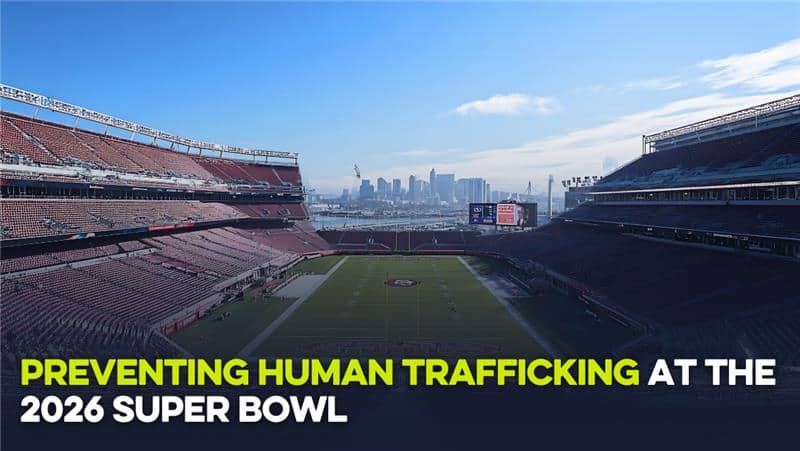
The Super Bowl is one of the biggest annual sporting events in the United States, drawing hundreds of thousands of visitors to its host city each year. Super Bowl LX will take place on February 8, 2026, at Levi’s Stadium in Santa Clara, California, home of the San Francisco 49ers. This marks the second Super Bowl at this venue and the third in the San Francisco Bay Area.
When thousands of people flood into a city for such a major event, public safety and human trafficking prevention efforts intensify. While no definitive data shows trafficking spikes specifically because of the Super Bowl, large influxes of visitors can create opportunities for traffickers to exploit vulnerable individuals.
Human Trafficking in California: What We Know
Human trafficking has been reported in every U.S. state, including California, exploiting people for commercial sex through force, fraud, or coercion. California is one of the nation’s most active states for trafficking reports due in part to its size and population.
According to the National Human Trafficking Hotline statistics for 2024:
- The hotline received 3,378 signals from California, with 1,298 reports coming from survivors or victims themselves.
- In the same year, 1,733 human trafficking cases were identified, involving 3,603 survivors.
- Of those cases, 1,064 were sex trafficking reports.
California’s statistics mirror a broader national trend: sex trafficking accounts for the vast majority of trafficking cases. Historical data from the Public Policy Institute of California shows that between 2015 and 2021, the proportion of cases involving sex trafficking increased from 87% to 89%, exceeding the national average.
Why Prevention Matters Around Major Events
Although specific Super Bowl–related trafficking statistics are limited, law enforcement and community groups emphasize awareness and work to prepare before and during the event. In the Bay Area, authorities and nonprofits warn that major events like the Super Bowl can increase the risk of human trafficking due to higher travel, hospitality, and tourism activity.
Local transportation agencies have held awareness events to prepare frontline workers and the public to recognize and report trafficking concerns at transit hubs and other key locations ahead of the Super Bowl weekend.
Experts stress that trafficking does not automatically increase because of the game. Instead, law enforcement, service providers, businesses, and the public must coordinate awareness and training to prevent exploitation.
Signs to Watch For
Recognizing potential signs of human trafficking can save lives.
- Inconsistent stories or explanations – they might give conflicting details about their circumstances or seem confused when asked questions.
- Lack of identification or control over documents – they may not have an ID, or someone else (such as an employer or trafficker) may be holding it.
- Uncertainty about location – they may be unable to clearly describe where they are staying or how they arrived there.
- Deference to another person – they may allow someone else to answer questions on their behalf or avoid speaking directly.
- Fear, anxiety, or hypervigilance – they may appear nervous, avoid eye contact, or act fearful around authorities or strangers.
- Running away or unstable housing –children without stable housing, or those abused or rejected at home, face higher risk of trafficking.
- Sudden changes in behavior or school attendance – they may skip school, withdraw from friends or family, or act differently than usual.
- Use of unfamiliar or street-specific language – phrases like “the game,” “the life,” or “handler/manager” may signal exposure to exploitation.
- Signs of physical or sexual harm – trafficked youth may have injuries, show signs of STDs, pregnancy, or require drug/alcohol treatment.
- Unexpected gifts or money – they may suddenly have expensive clothing, electronics, or cash without a clear source, sometimes claiming friends provided them.
Recognizing these signs and reporting them to local law enforcement or the National Human Trafficking Hotline can lead to intervention and support for survivors.
How You Can Help
Large events like the Super Bowl bring excitement and celebration, but they also require collective vigilance to protect vulnerable people. You can make a difference by:
- Report any suspicions of trafficking to 911 immediately, or call the tips hotline at 1-888-373-7888.
- Learning the signs of exploitation to identify and report potential trafficking.
- Sharing resources with friends, family, and fellow fans traveling to Super Bowl LX.
- Supporting local and national outreach efforts aimed at education, prevention, and survivor care.
By making human trafficking prevention a community priority during major events like Super Bowl LX, we can help ensure public safety and dignity for everyone.
FAQ: Human Trafficking at the 2026 Super Bowl
1. Are large sporting events like the Super Bowl high-risk for human trafficking?
Large events, including Super Bowl LX, attract thousands of visitors, which can create opportunities for human traffickers. While data does not show automatic spikes in trafficking, authorities emphasize awareness and training for venue staff, hotels, and transit workers to spot suspected human trafficking and protect potential victims.
2. What forms of trafficking are reported in California around major events?
In California, sex trafficking makes up the majority of reported human trafficking cases, but labor trafficking also occurs. Traffickers may exploit sex workers, minors, or vulnerable adults through forced labor or commercial sex. Law enforcement and nonprofits monitor high-risk areas, such as transit hubs and hotels, during Super Bowl weekend.
3. How can people attending the Super Bowl help prevent trafficking?
Fans attending the 2026 Super Bowl in San Francisco can report suspicious activity and support human trafficking prevention efforts. Noticing unusual behavior, like people being controlled by others or sudden movement between hotels and transportation, can help authorities intervene. Anyone can contact the National Human Trafficking Hotline to report concerns.
4. How do law enforcement and Homeland Security respond during Super Bowl week?
Local law enforcement agencies, Homeland Security, and federal partners increase patrols, conduct awareness training, and collaborate with hotels, transportation services, and venues. Their goal is to identify human traffickers, protect human trafficking victims, and prevent exploitation during the Super Bowl event.
5. Are there signs of human trafficking fans and attendees should watch for?
During Super Bowl week, watch for suspicious activity. Prompt reporting can prevent further harm to potential victims.
6. Has trafficking been reported at past Super Bowls?
While confirmed statistics vary, authorities use these events to improve human trafficking prevention strategies for all large sporting events.
7. How can organizations participate in human trafficking prevention during the Super Bowl?
Nonprofits, hotels, transportation providers, and local businesses can join outreach campaigns to raise awareness of human trafficking risks, distribute resources, and report suspected human trafficking. Collaborative efforts during Super Bowl week help protect trafficking victims and support human trafficking survivors.
8. Why is it important to focus on Super Bowl LX in San Francisco?
With thousands of fans attending from across the United States, Super Bowl LX at Levi’s Stadium presents both opportunity and responsibility for trafficking prevention. Increased attention from law enforcement, community partners, and public education can reduce the risk of sex trafficking and exploitation during this large event.
9. How can fans learn more about supporting human trafficking prevention?
Fans can visit the National Human Trafficking Hotline and can also learn to recognize signs of human trafficking, understand reporting procedures, and share resources to prevent human trafficking.