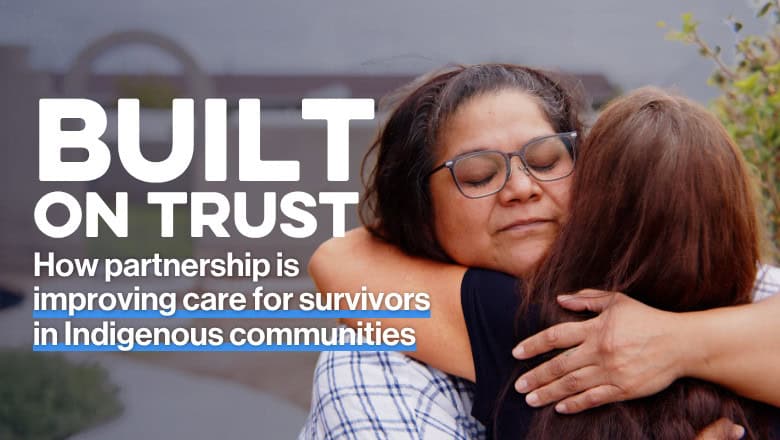
How Partnership Builds Trust and Improves Care for Survivors in Indigenous Communities
On Indigenous People’s Day, June Haskell, Director of Survivor Engagement Strategic Partnerships at Our Rescue, reflects on a recent Tribal Advocate Gathering in Blanding, Utah, and why investing in the advocates who serve survivors across tribal and rural communities matters. Drawing from her own experience with a victim advocate at age 12, June shares why relationships, trust, and community-led expertise are central to this work.
I was 12 years old when I had to testify against the man who hurt me. I was terrified, but I had a victim advocate who stayed by my side the entire time, helping me through the process. I didn’t understand the systems around me or know what was supposed to happen next. I was just a child whose world had been turned upside down. That advocate stayed by my side, step by step, helping me understand what was happening. She made an overwhelming experience feel a little less frightening and a little more manageable.
That experience has stayed with me all these years. And when I find myself in a room like this Gathering, I look around and can’t help but think about the other 12-year-old girls, and survivors of every age, who may one day find themselves sitting across from one of these advocates during one of the hardest moments of their lives.
Lived experience has taught me that good intentions alone are not always enough. An advocate can care deeply about supporting survivors and have the best intentions but still fall short if they lack certain training, tools, and resources. Even the most experienced advocates need the right training, resources, cultural understanding, and trauma-informed tools. This is especially important because the quality of an advocate’s response can impact a survivor long after the immediate crisis has passed.
That is why investing in advocates matters so much to me. When we help advocates get access to trauma-informed, survivor-centered training, resources, relationships, and support, that investment has the potential to extend far and wide into the future. We’re strengthening what may someday be a survivor’s first experience of being truly understood, believed, supported, and shown what comes next.
The Gathering: Establishing Connections
In August, Our Rescue partnered with the tribal advocates and the Utah Domestic Violence Coalition to support a Tribal Advocate Gathering in Blanding, Utah. This training, called “The Gathering,” brought together advocates and other professionals who work with tribal and rural communities across the State of Utah and the Four Corners region. The group of professionals in the room represented decades of experience working with survivors of domestic and sexual violence response, Missing and Murdered Indigenous Relatives (MMIR), human trafficking and exploitation. Some were specialists in victim advocacy and SANE/forensic response, or represented shelters, law enforcement, and community-based organizations.
Many of the advocates who participated serve large geographic areas and work within complex systems with limited staff, funding, and resources. Even when opportunities for training, collaboration, or professional development exist, obstacles can get in the way. Participation can mean driving for hours, paying for gas and lodging, and trying to find someone to cover their shift at work. Or worse: some organizations simply don’t have the budget to attend.
With support from Our Rescue and the Patz Foundation, we were able to help remove some of those practical barriers with assistance for lodging, transportation, meals, and other expenses related to the event. We are grateful for the opportunity to help because what unfolded in the Gathering was the start of something powerful.
The Gathering created space for people with diverse backgrounds and different areas of expertise to meet, exchange resources and ideas, learn together, and begin relationships that can strengthen the response to survivors across a sometimes-vast landscape of communities and jurisdictions. An MMIR leader meets a SANE/forensic professional, who talks with a tribal victim advocate, who connects with a domestic violence coalition or other organization working in a neighboring jurisdiction. And this happens in real-time, face to face, all at once.
These relationships matter when, months later, an advocate encounters a survivor who needs help from multiple entities, from the professionals, agencies, and tribal organizations that shared a table at the Gathering. This experience strengthens connections and expands the network of people, organizations, and resources available to advocates. From the Gathering, they have contacts they can call on when needed; they have had the opportunity to establish relationships and gain additional expertise that will fortify the work they do with survivors.
Building Relationships: Trust Takes Time
An equally important part of this story is how we are approaching these relationships.
I have been working with tribal nations and tribal advocates for more than five years, building relationships grounded in trust and mutual respect. I was accompanied by a colleague from another team at Our Rescue. He helps capture experiences, voices, and partnerships that are important in our work. I am grateful to see that the relationships I have established are now able to open doors, new opportunities, for Our Rescue to begin building and earning trust as an organization in the community of advocates.
Getting permission for my colleague to attend the Gathering with me was a process; it was not assumed or taken for granted. I felt it was important for my colleague to meet with participants in advance of filming to help establish a new relationship based on mutual respect and trust. This could help participants decide if and what they were comfortable sharing. His genuine approach, combined with the relationships and trust I had already established, helped participants see him as another person they could trust and respect. This created a new connection we could continue building on, and as participants became more comfortable with us, they welcomed us into conversations, interviews, and interactions we had not previously been invited to capture.
We intentionally did not approach the Gathering as an opportunity to ask people to share their most difficult cases, community challenges, or personal stories on camera. And it was always very clear that access to these stories – let alone to share them with others – had to be earned.
Trust takes time, especially when you’re working with communities that have experienced outsiders who enter, gather information, and leave. Our top priority is listening. Through listening, we build genuine relationships, and we seek to understand what communities and advocates need. We support work that is already happening and demonstrate that when people do entrust us with their stories, we represent them responsibly.
That’s what makes me feel this Gathering is “Chapter One” in a longer story that continues to grow. My hope is that by bringing greater awareness to the work already happening in these communities and showing what is possible through meaningful partnership, we can encourage others to come alongside it as well – bringing new partners, resources, and opportunities for support. For me, the Gathering represents the beginning of relationships we hope to continue building, and opportunities for deeper partnership, learning, and storytelling.
Encouraging Understanding: Sharing Stories, Ideas, and Best Practices
The organizations and leaders connected to the Gathering represent a wide range of survivor-centered expertise and important work that deserves greater visibility and understanding. I’m referring to entities like the Utah Domestic Violence Coalition, Restoring Ancestral Winds (RAW), MMIR Utah, Utah Navajo Health System (UNHS), tribal victim advocates, domestic and sexual violence advocates, and many others. These are essential workers – the advocates, professionals, community and organizational leaders, and others with significant expertise – who are doing the critical work to support survivors and strengthen responses within their communities.
As these relationships grow, there may be opportunities to return and dive deeper into the stories they are able to tell, and to learn from and discuss the issues or trends they are seeing. We may have additional opportunities to explore the solutions they are developing, the barriers their communities face, and the work they believe more people need to understand.
Early on, Our Rescue met with our donor, Monica King and the Patz Foundation, and with the Gathering’s AJ Hunt. We discussed and agreed that Our Rescue was not the focal point of this story, or of this event. It was clear to all that our role would be to listen, support, and to help remove obstacles wherever possible. It would be to use Our Rescue’s platform to help amplify the people already doing the work, responsibly, respectfully, and with gratitude for being invited to be part of the conversation.
We have been entrusted with something that transcends the work we do today: given an opportunity to support meaningful partnership and dialogue, not because we know the answers but because we don’t. We are grateful to be in the room and part of this process, whether that’s physically in the Gathering face to face with counterparts, or in the broader space that was created because of that meeting.
Sometimes supporting meaningful change involves making sure those with significant barriers can be present, so that they can participate directly and from others as well as contribute from their own experiences. The Gathering demonstrated how relatively straightforward support for practical things like travel, lodging, and meals can have a positive impact on attendance and inclusion.
This Gathering is a tangible example of Our Rescue’s mission being carried out through partnership. We don’t “own, lead, or manage” this space – we’re simply part of the current, listening for ways to support and for opportunities to expand and strengthen support for the work that is already underway. And as relationships continue to develop, we hope to identify additional ways that Our Rescue, our donors, and our partners can help support local needs with training, professional development, survivor resources, capacity building, and other opportunities to elevate the expertise and work already occurring inside these communities.
There is so much to learn and so much to share. Thanks to generous donors like Monica King and the Patz Foundation, Our Rescue can do our part to help ensure this dialogue continues and is made accessible to more advocates, professionals, and coalitions that are on the frontlines fighting to end human trafficking and child exploitation.
I think about the Gathering, all the advocates and associated professionals who work with survivors assembled in that room together, and I remember the 12-year-old in me. A girl whose world had become a frightening, confusing place where nothing made sense. I remember how thankful I was to have an advocate beside me during that time. It brings me hope to know that moments like the Gathering are helping to make sure that when another 12-year-old girl finds herself alone and scared, and doesn’t know what comes next, there will be someone beside her who does.