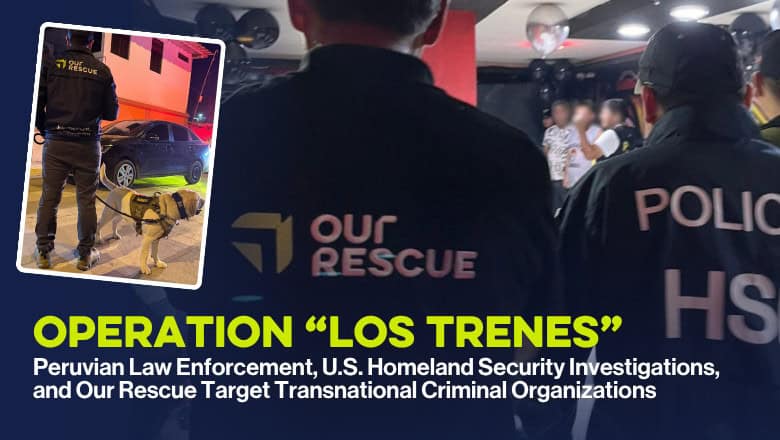
Over the course of two days, April 29-30, 2026, Peruvian and U.S. law enforcement agencies came together to execute a concentrated “Mega Operation” appropriately named “Los Trenes” after the Transnational Criminal Organizations (TCOs) they aimed to bring down. With on-the-ground support from Our Rescue, this operation intended to disrupt and dismantle a criminal network that was suspected of leaving a trail of human trafficking, sexual exploitation, extorsion, and homicide across Peru, Venezuela, and Colombia.
Drawing on Multi-National Support to Execute a Mega Mission
Authorities leading the mission came from the Peruvian regions of Amazonas, Apurimac, Arequipa, Cajamarca, Ica, Junín, La Libertad, Lambayeque, Piura, and Tumbes. The Peruvian National Police (PNP) and Directorate of Human Trafficking working in conjunction with the Specialized Prosecutors Office for Organized Crime, joined U.S. Homeland Security Investigations (HSI), a division of the Department of Homeland Security, and Our Rescue’s Latin America team to carry out the operation, an effort that spanned eight regions across Peru.
Law enforcement targeted three criminal networks: Tren de Aragua, Hijos de Dios, and Tren de Llano. These TCOs are known for engaging in Human Trafficking and Sexual Exploitation of foreign nationals. Authorities detained twenty-eight people presumed to be members of the organized criminal networks, Hijos de Dios and Tren de Llano. They were allegedly keeping women trafficked from Venezuela and Colombia in Peruvian hostels and nightclubs.
For this operation, Our Rescue’s Latin America team provided extensive logistical support prior to, during, and after this complex, multi-national effort.
Joint Efforts Help Rescue Peruvian and Venezuelan Nationals and Bring Criminals to Justice
This nationwide Mega Operation resulted in the arrest of 28 people, of whom 17 are men, and 11 are women. Of the arrests, five were Peruvian nationals and 23 were from Venezuela. All 28 individuals involved were arrested and detained under judicial authorization of preliminary detention for 15 days, allowing the PNP to further strengthen the criminal charges which ranged from human trafficking and sexual exploitation to extortion and homicide.
According to police reports, two TCO leaders were arrested during the operation. One leader, a Venezuelan woman known as “Glorimar,” was captured in the City of Jaén and was said to be responsible for recruiting women through social media platforms, luring them to Peru with the false promise of stable, good-paying jobs. The other, known as “Comiquita,” was the leader of Los Hijos de Dios and was arrested in the City of Abancay.
Lending Logistical Support and On-The Ground Specialized Resources
In addition to participating in the Mega Operation, Our Rescue has been supporting a longer-range, international and LATAM-focused effort as investigations of TCOs unfold.
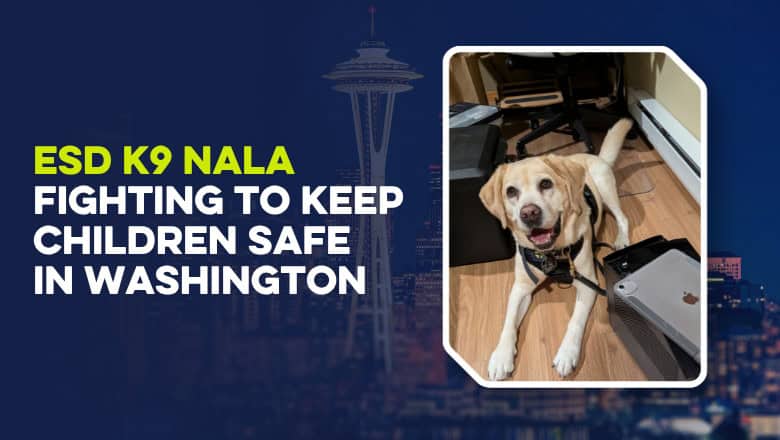
Aware of the broad reach and severity of the three “Trenes” TCOs, Our Rescue has provided logistical support including but not limited to vehicle rentals for surveillance and operations, air transportation for police personnel and survivors, and specialized equipment provided to the PNP and Directorate of Human Trafficking. Our Rescue has also engaged one of its Electronic Storage Detection (ESD) K9s that can find hidden electronic storage devices like cell phones, hidden cameras and tracking devices, hard drives, and USB drives, which can contain key evidence.
Our Rescue Helps Ensure Survivors’ Needs Are Met
The Mega Operation was rooted in two years of deep investigative work. During that time (2023-2025), Our Rescue supported numerous law enforcement operations with the identification of members and the structure of these criminal organizations. Assistance included but was not limited to logistical transportation for police personnel to different regions of Peru, as well as food provisions during these operations some of which were based in remote locations.
These efforts resulted in criminal arrests and the rescue of 43 survivors that were trafficked to Peru under the false pretense of legitimate job opportunities, then subsequently sexually exploited by the criminal organizations.
Survivors received kits containing food, essential clothing and personal hygiene products, and blankets. Our Rescue helped ensure survivors were placed with safe shelters and connected them with emotional and psychological support. Our Rescue also coordinated with multiple diplomatic consulates based in Peru, helping survivors return home.
Forty-three survivors were brought to safety during this operation, and 37 of the rescued individuals have returned to their home countries to begin rebuilding their lives. Five survivors chose to remain in Peru and are reintegrating into society, some already gainfully employed and learning new job skills. One survivor returned to Colombia to begin her healing journey while the others remained, fearing for their safety.
The survivors of this intensive, multi-year collaboration were predominantly young Venezuelan women, 95 percent of whom were between the ages of 18 and 24. They were lured away from eleven cities in Peru, dreaming of stable jobs and good pay. All false promises. These cities became the central hubs of the operation, divided into three zones each with a PNP Coronel overseeing and coordinating law enforcement activities. Teams targeted night clubs run by the “Trenes” TCOs as fronts to exploiting young, vulnerable Venezuelan women, catching them in a web of human trafficking and sexual exploitation.
“The physical conditions where the female victims were forced to provide sexual services were described as filthy, inhumane, and prison-like,” described one team member involved in the operation.
Our Rescue’s Survivor Care team gave assistance and care to the individuals who had been brought to safety, some of whom were minors. Many survivors needed resources like immediate safe shelter, psychological and emotional support, meals, vocational training, and transportation assistance from Lima back to their home countries.
Those who survive being victimized by a TCO have often been subjected to extreme violence, coercion, and inhumane living conditions. Many of their stories reflect the harsh reality faced by migrants fleeing the economic collapse and instability of countries like Venezuela, only to encounter violence and sexual exploitation when they arrive in Peru.
“These survivors are extraordinarily courageous,” said one team member of Our Rescue. “They have endured unimaginable circumstances and are now reclaiming their lives with strength and resilience.”
“During Operation Trenes, a significant blow was dealt to TCOs that are deeply involved in human trafficking and the sexual exploitation of vulnerable migrants seeking a better life in Peru,” said another team member. “What we have accomplished as partners in this international collaborative effort is what we must continue to do. It is the way we shut down these criminal networks and bring justice and the opportunity to begin the healing journey to those who have survived.”
An Infinite State of Servitude: The Cyclical Sexual Exploitation by Trenes in Peru
In an attempt to avoid internal conflict among factions, Tren de Aragua and its “affiliates” apparently divide the responsibility of controlling human trafficking activity across ten regions in Peru. One Peruvian prosecutor said the organization often “sold” victims from one faction to another, perpetuating a cycle of sexual exploitation. This system created a cycle of “sexual slavery:” TCOs applied steep “debts” to trafficked individuals for various essentials (giving them meals, clothes, etc.) and those debts were to be paid through sexual acts. Once a victim was purchased by a new TCO, that debt started over, keeping the trafficked individual in a potentially infinite state of servitude.
The Tren de Llano and Hijos de Dios TCOs maintained strict control over central plaza areas in Peruvian cities. Victims were closely surveilled. The Trenes used physical and psychological violence as tools to ensure compliance and obedience. One prosecutor’s office said victims testified that they were driven to “complete desperation” due to being physically confined and coerced to provide sexual services. Facing extreme desperation, some victims attempted to escape their captors and some committed suicide.