When a five-year-old boy met a police dog named Zero at a victim services conference this spring, he didn’t know he was witnessing a quiet revolution in how law enforcement handles some of the hardest cases imaginable. He just knew the dog was good, and the officer standing beside him was kind. Weeks later, he was still telling his mother he wanted to grow up to be “a police officer like Detective Bassett.”
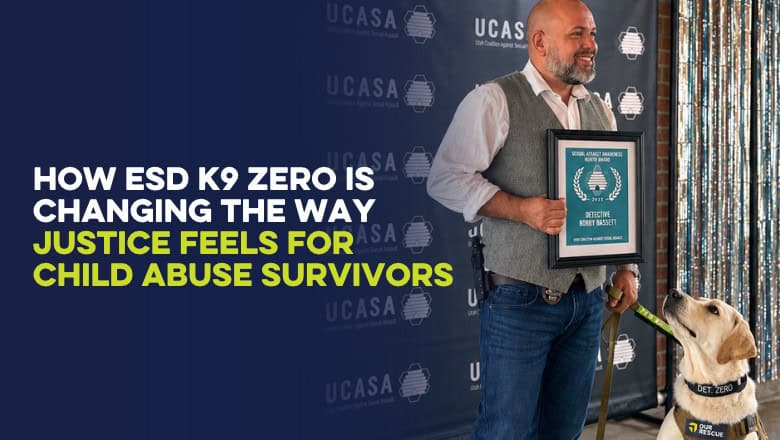
That mother happened to be Liliana Olvera-Arbon, Executive Director of the Utah Coalition Against Sexual Assault (UCASA) and she had already seen, professionally, exactly what her son felt instinctively. In April, UCASA recognized Grantsville Police Department’s Detective Bobby Bassett and his ESD K9 partner, Zero, with its top law enforcement honor during Sexual Assault Awareness Month. The ESD K9 Unit had received multiple nominations from advocates, prosecutors, and colleagues who had watched them work.
Bassett tried to deflect the credit. Zero, of course, had no comment and enjoyed the praise! But the honor wasn’t really about a single detective or a single dog. It was recognition of something Our Rescue has known and been advocating for years: that a well-trained K9 can be one of the most powerful and most overlooked tools in the fight to protect children.
Why a Dog Changes Everything
Support for child abuse and human trafficking cases can come from various sources. Forensic interviews, courtroom testimony, social services providers, even the drive to the police station are steps that vulnerable children, already traumatized by what has happened to them, can dread. And at every turn, these children are asked to trust the men and women in uniform. This can be an emotionally charged, difficult time for child survivors.
That’s where an ESD K9 like Zero, who is also trained as an emotional support (therapy service) dog, earns the title: a force multiplier. A dog doesn’t ask questions. He (or she) just sits, leans, and lets a child pet its ears or wrap their arms around their neck while the hardest conversation of their life happens, a little more bearable. A little less painful.
Olvera-Arbon put it simply: trauma-informed care means meeting survivors with compassion and meeting their needs as individuals, whatever form that takes; sometimes tears, sometimes silence, sometimes a small hand buried in a dog’s fur. Zero epitomizes that principle on four legs.
Our Rescue’s Role: Funding the Force Multiplier
Departments like Grantsville PD don’t stumble into K9 programs like this. They’re expensive, specialized, and easily underfunded in police budgets that are already stretched thin. That’s the gap that Our Rescue id dedicated to see closed.
Our Rescue funds the full lifecycle of ESD K9 placements with law enforcement agencies: the specialized training with Jordan Detection K9 that prepares a dog for trauma-informed work, the cost of placing that dog with a handler and department, ongoing food and gear, non-emergency veterinary care, and the annual recertification of every ESD K9 unit. It’s not a one-time grant. It is a sustained partnership that keeps dogs like Zero in the field, healthy, certified, and ready, year after year.
That support is deliberately unglamorous and stays behind the scenes. But it’s the difference between a department having a Zero and not having one; between a child facing an interview alone or facing it with a warm, patient dog leaning against their leg.
A Model Built to Travel
What makes this work matter beyond Grantsville is that it’s replicable. The same funding model which includes training, placement, gear, sustainment, and recertification, can support ESD K9 units in departments and child advocacy centers across the United States, in Canada, and in the international communities where Our Rescue fights human trafficking and child exploitation every day. Every agency that adopts an ESD K9 is, in effect, adopting a proven method for making disclosure less traumatic and prosecution more successful. In addition, it’s a resource available to the very police officers, ICAC task force investigators, and countless others on the frontlines of this fight – a comfort that helps ease the burden they carry form working these difficult cases, day after day.
Detective Bassett said the recognition wasn’t about him: “It reflects the dedication and teamwork of so many people who work hard every day to support victims and hold offenders accountable.” Zero would likely agree, if he could talk…which is, in the end, exactly the point. He doesn’t have to.