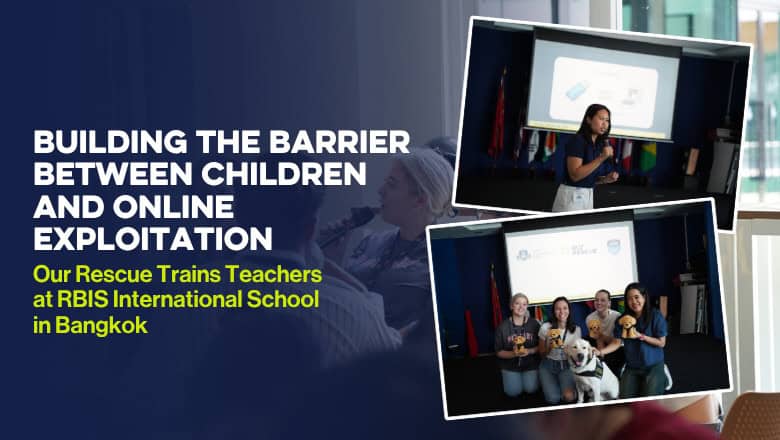
Recently at RBIS International School in Bangkok, Thailand, Our Rescue’s Training & Prevention team, in collaboration with the survivor care team conducted a special, in-depth training for teachers and staff. The topic? Helping teachers and staff members prevent, identify, and respond to online child exploitation.
UNICEF’s 2022 Disrupting Harm report in Thailand showed that about 9 percent of children between the ages of 12 and 17 who use the internet experienced severe forms of online sexual exploitation and abuse in a single year. That 9 percent represents roughly 400,000 children. The report also shows that only 1 to 3 percent of children reported these incidents to authorities. This is how child sexual abuse and exploitation stay hidden. Our Rescue emphasizes the importance of staying engaged: it is imperative for schools and trusted adults to learn and be aware of the warning signs and to take responsibility, putting that knowledge to work to help identify and respond – early and quickly – to online threats against children.
The training at RBIS International School effectively strengthened teaching staff’s knowledge and capacity to prevent and respond to Online Sexual Exploitation of Children (OSEC). Key threat areas including online grooming, sextortion, and CSAM were covered by the Training & Prevention Team in collaboration with our Survivor Care Team. Our Rescue team members explained the principles of trauma informed care, examining how exploitation affects children long after the initial harm has occurred. Instructors helped participants understand what survivors may experience, and how adults can respond in ways that avoid causing further harm.
Participants then took part in an interactive presentation with Our Rescue-sponsored Electronic Storage Detection (ESD) K9 “Winner,” demonstrating digital forensics detection. This presentation enabled teachers and staff to see firsthand how our specialized ESD K9s work quickly and efficiently to identify and secure digital evidence. The group discussed how electronic storage evidence like cell phones, USB drives, hard drives, SD cards, and even hidden cameras can play a pivotal role in the identification of suspects, in arrests, investigations, and in prosecuting cases. Detecting this evidence can help put predators behind bars and keep children safe.
The Anti Trafficking in Persons Center of the Royal Thai Police (TATIP) also recognized the program and contributed practical expertise throughout the training. Officers shared real case examples, tactics offenders use to lure and exploit, legal frameworks, and reporting procedures. This insightful input helped participants connect the training to real-life investigative work and strengthened its practical value for those in attendance.
One of the critical results of this training was the creation of an open space for meaningful dialogue, sharing ideas and experience, and deeper collaboration. Our Rescue emphasized a shared commitment among participants to continue exploring complex areas of digital exploitation and to strengthen clarity around response pathways.
We are incredibly grateful to RBIS International School, the Training & Prevention team, the Survivor Care team, ESD K9 Winner and his handler Bank, and to the Anti Trafficking in Persons Center for their partnership and commitment to keeping kids safe in digital spaces.
This work is possible because of our generous donors. Please donate today to help us meet the growing demand for more efforts like this around the world. Protecting children from online predators begins with knowledge and awareness, and our ability to prevent, identify, and respond to child exploitation only gets stronger when we work together.