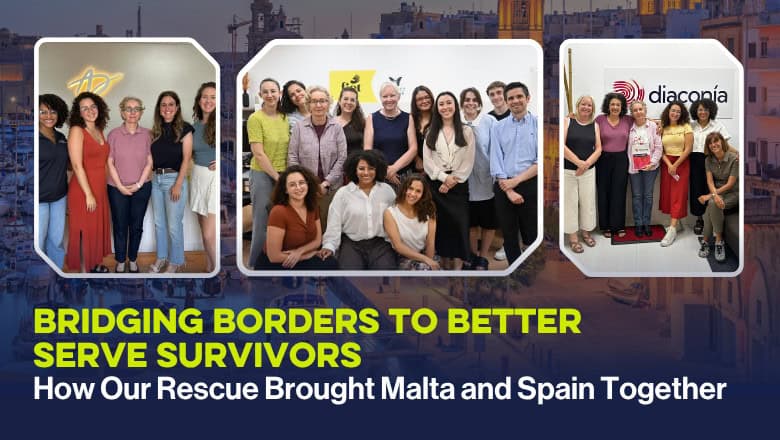
When it comes to fighting human trafficking, no single organization, no single country, has all the answers. Our Rescue believes we strengthen outcomes when we work together, across borders, disciplines, and private and public sectors. Recently, Our Rescue helped organize an international learning exchange between anti-trafficking organizations in Malta and Spain, bringing frontline advocates together to share strategies, compare survivor care models, and strengthen the global network fighting for survivors of human trafficking. This international effort was organized by Tyra Omeir, Director of Survivor Care, for Our Rescue’s Europe Team.
“I firmly believe that collaboration is the only way forward in the fight against human trafficking,” said Tyra. “Creating opportunities for partners to share their expertise is an impactful way to improve the support available to victims and survivors.”
“Organizing this exchange between two of our partners in Europe was one small but important step toward that goal,” she added.
Human trafficking doesn’t respect borders, and neither should the solutions to it. Survivors in Malta and survivors in Spain face different legal systems, different cultural contexts, and different resources. But they share the same need: trauma-informed, effective, and sustained support on their survivor journey.
The cross-national exchange aimed to strengthen shelter management and survivor-centered care through in-person meetings and discussions on trauma-informed programming. Staff from Agenzija Appoġġ in Malta and Fiet Gratia in Spain spent time sharing their experiences, discussing challenges, and exchanging practical approaches to supporting survivors. The overall goal was to identify best practices, learn from one another, and explore opportunities for long-term collaboration that would ultimately improve services for survivors in both countries.
As part of the exchange, Fiona Belshaw, Founder of Fiet Gratia, traveled to Malta to meet with the team at Agenzija Appoġġ. She visited their shelter and engaged with key stakeholders, including the International Organization for Migration (IOM), Aditus, and Malta’s Human Rights Directorate. These conversations created space to discuss the realities of supporting survivors in Malta, the gaps that still exist, and the value of working together across borders.
Following Fiona’s visit, Elvira Zerafa and Francesca Camilleri from Agenzija Appoġġ, part of the Foundation for Social Welfare Services (FSWS), traveled to Madrid to continue the exchange. They were joined by Tyra, who participated in the exchange and discussions. Together, they gained a deeper understanding of Fiet’s holistic approach to combating human trafficking and supporting survivors as they rebuild their lives. One of the most meaningful moments of the visit was meeting with a group of survivors who generously shared their experiences and reflected on the services and programs that had the greatest impact on their journey from exploitation to independence.
While in Spain, the staff from Appoġġ also met with Spanish NGOs Diaconía and Amar Dragoste, to learn about their approaches to working with survivors.
“Through shelter visits, professional discussions and street outreach activities, we gained valuable insight into trauma-informed, person-centered and multidisciplinary approaches to supporting victims and survivors of human trafficking,” said Elvira Zerafa with Agenzija Appoġġ. “The visit highlighted best practices relating to admission procedures, risk assessment, therapeutic and legal support, safeguarding, digital safety, staff wellbeing, and the promotion of residents’ independence.”
“Key recommendations for FSWS include introducing a structured welcome kit and phased admission process, strengthening digital safety and legal support, reviewing afternoon staffing levels, expanding life-skills and income-generating activities, and exploring the development of a specialized outreach and identification team in Malta,” added Elvira.
The exchange concluded with a street outreach alongside the Fiet Gratia team, where we witnessed firsthand how trafficking happens in plain sight. It was a powerful reminder that exploitation often occurs right in front of us, and that communities, entities, and everyday people all have a role to play in recognizing the signs and helping those who are being exploited.
“What made this exchange especially meaningful was that it wasn’t simply about observing another organization’s work,” said Tyra. “It was about building relationships and gaining tools to create lasting change. When we invest in one another’s knowledge and experience, we strengthen our collective ability to serve survivors with dignity, compassion, and excellence.”