By Amy Bruins, Vice President of Community Impact at Our Rescue
Grooming rarely announces itself. It often begins quietly—with attention, encouragement, shared interests, or support—long before boundaries are crossed or risks are recognized.
Because grooming is a deliberate, relationship-based process rather than a single event, it can unfold anywhere children and young people communicate or build trust, both online and offline. Grooming can happen to any child. Understanding how grooming works, recognizing early warning signs, and investing in prevention are essential steps families and communities can take to reduce risk and protect children before harm occurs.
What is Grooming?
Grooming is often misunderstood as something that happens only on social media or messaging apps. Grooming is behavior-based, not platform-based. While most grooming activity occurs online, it can occur anywhere a young person is communicating, interacting, or building relationships—whether in digital spaces, community settings, or everyday offline environments.
Perpetrators can be someone familiar to a child or teen or a stranger. They may identify as any gender. Perpetrators often disguise their identity and age behind fake online profiles. They target any age, gender, sexuality, and social or cultural background.
Grooming typically involves an adult (or sometimes another youth) intentionally building trust with a child for an exploitative purpose. It may also start with by a perpetrator first gaining access to child by gaining trust with their parents, caretakers, coaches, etc. Often this process looks like:
- Offering attention, validation, or emotional support (this may happen while the predator targets vulnerable youth and adults)
- Creating a sense of specialness or exclusivity
- Gradually introducing secrecy or boundary violations
- Normalizing and escalating inappropriate requests or conversations
Importantly, grooming often does not feel dangerous at first. It frequently resembles mentorship, friendship, love, or care—especially to a child or young person who is seeking connection, belonging, or affirmation.
Grooming may begin online and later move offline, or it may start in a physical setting and continue digitally. Because grooming is behavior-based—not platform-based—it is not limited to any single app, space, or environment. Common environments include:
- Interactive online environments, such as games or shared digital experiences where communication is built in
- Messaging features and chat functions, including direct and group conversations
- Online communities and forums, where shared interests can quickly create a sense of belonging
- Peer-to-peer digital spaces, where connections often feel informal and trusted
- In-person environments, such as schools, sports teams, faith communities, and neighborhoods
What matters most is not where a child is, but how a relationship develops within that space. Grooming occurs when communication becomes a pathway to trust, influence, and eventually control.
Once grooming has begun it may lead to:
- Requests for personal information or images
- Pressure to meet in person
- Long‑term emotional manipulation
- Coercion (defined as psychological or emotional pressure used to compel a victim to comply with sexual demands, such as threats, manipulation, intimidation, abuse of power, or exploitation)
- Sextortion (or sexual extortion) (defined as when an offender threatens to share a victim’s real or fabricated sexual images or videos unless the child provides additional explicit content, engages in sexual activity online, or sends money).
Grooming is difficult to recognize because it often blends seamlessly into everyday interactions. Here are two real-world examples:
- A young person meets someone in an online environment who shares the same interests. Over time, that person becomes a consistent source of encouragement and emotional support—especially during a difficult period. As trust builds, the conversation gradually shifts to more personal topics, then to requests for privacy or secrecy.
- An adult or older peer in a community setting takes a special interest in a child’s activities or talents, offering extra attention, mentorship, or opportunities. Over time, the relationship becomes more exclusive, with subtle pressure to keep aspects of the connection private or separate from others.
In each example, the relationship made the child feel important, safe, and special, which is how grooming can be so effective.
For a deeper explanation on how online grooming works and why it is so effective read our blog How Online Grooming Fuels the Growing Digital Child Exploitation Crisis
Common Myths About Grooming
It is important to know what grooming is, but it is equally important to know how our perceptions of grooming may be inaccurate. Here are some common grooming related myths:
Understanding what grooming looks like means confronting some of the most persistent misconceptions that leave children and families less protected.
Myth: Grooming only happens on social media. Grooming is behavior-based, not platform-based. It can occur anywhere a young person communicates or builds relationships — in gaming environments, messaging apps, online communities, sports teams, faith organizations, schools, or neighborhoods. Limiting access to one platform does not eliminate risk if the underlying behaviors and vulnerabilities go unaddressed.
Myth: My child does not have a smartphone, so they’re safe. Grooming can occur through any device with communication capability — a gaming console, a shared family tablet, a school-issued laptop, or a friend’s phone. Younger children are not exempt. Groomers target children across ages, and access to a personal smartphone is not a prerequisite.
Myth: My child is too smart to fall for this. Grooming is not a trick that only works for naive or inattentive children. It is a deliberate, gradual process specifically designed to feel safe, caring, and normal — often resembling mentorship, friendship, or genuine affection. Intelligence does not protect against a relationship that is intentionally built to deceive. Any child seeking connection, validation, or belonging can be targeted.
Myth: Grooming takes a long time — I would notice. While grooming can unfold over months, it can also accelerate quickly depending on a child’s vulnerability and a groomer’s access. Warning signs are often subtle, and by the time explicit harm occurs, trust has already been established and secrecy normalized. Early awareness — not just recognition after the fact — is what makes the difference.
Myth: My child has plenty of friends, so they will not be targeted. Having an active social life does not eliminate risk. Groomers are skilled at identifying and meeting unmet emotional needs — a child going through a tough time at home, navigating social conflict with peers, or simply seeking a sense of being truly understood. It is also important to recognize that for many children today, online friendships carry the same emotional weight as in-person ones. A “friend” a child has never met in person may feel just as real, trusted, and significant as someone they see every day — which is exactly what makes online grooming so effective.
The Grooming Process: Prevention and Early Awareness Matter
Grooming is rarely sudden. It is gradual and adaptive, responding to access, opportunity, and vulnerability. Grooming victims may not recognize the intentional manipulation they are experiencing because the relationship initially meets a real emotional or social need.
Common stages in the grooming process can include:
- Relationship‑building through shared interests
- Trust‑building via empathy, humor, or support
- Boundary‑testing, such as increasingly personal questions
- Secrecy, often framed as protection or loyalty
- Escalation, which may involve coercion, image sharing, or offline contact
It is no longer accurate—or helpful—to treat online life and “real life” as separate worlds. For children and teens, digital spaces are extensions of their social lives, friendships, and identities.
Indicators or warning signs of grooming may include:
- Increased secrecy around online activity or relationships
- Emotional reliance on a new friend or adult
- Overly sexualized jokes or knowledge for age
- Unexplained gifts or money
- Withdrawal from friends, family, or activities
- Strong reactions when access to devices or platforms is limited
- Requests for privacy that feel developmentally inappropriate
These indicators should be met with caution and reflection – a child or young person may exhibit all, some, or none of these indicators. Indicators alone do not determine whether grooming is happening. Parents, caretakers, and teachers, who have intervened in cases of exploitation, have reported sensing something feeling “off” in their interactions with the affected child. 
From a parent and caretaker perspective, warning signs can be subtle—especially when grooming is mixed into normal online activity or peer interaction. It is important to educate parents, caretakers, children, teens, and communities on online safety and how to recognize and respond to signs of grooming.
It is important to start talking to our children and young people about grooming, along with other present-day exploitation risks. The goal is not surveillance or interrogation – it is presence, curiosity, open conversation, and knowing when and who to ask for help. The antidote to shame and harm is support and knowledge.
Prevention is Protection: What Communities and Families Can Do
Grooming is most effective when it goes unnoticed. By the time explicit harm occurs, trust has often already been established, boundaries gradually eroded, and isolation introduced. Early education helps adults and young people recognize that grooming behaviors often feel normal or even positive at first. When families, schools, and communities share a collective understanding of grooming tactics—such as secrecy, emotional manipulation, and boundary testing—they are better equipped to notice subtle changes and intervene before exploitation escalates. Prevention shifts the focus from reacting to harm to recognizing risk early when protective action is most effective.
Prevention also reduces shame and isolation for children and teens. Young people who have been taught that grooming can happen to anyone, and that it is never their fault, are more likely to speak up when something feels uncomfortable.
Remember – preventing grooming is not about controlling children’s lives. It is about equipping both adults and young people with shared language, knowledge, and skills, to prevent harm from happening, and how to seek help, if it does.
With the end of the school year upon us, learners will transition from school to summer vacation, creating a shift in how and where young people spend their time. They will have more unstructured time and increase engagement with online platforms. The time is now to train our families and communities.
1. Equip Adults through Training
Adults may feel underprepared, particularly as technology and tactics evolve. Staying up to date on training assists with having ongoing and topical conversations with children and young people about safety.
These trainings are available in instructor‑led formats (in person or remote) and as self‑paced eLearning, making them accessible for families, schools, faith groups, youth organizations, and community leaders.

Discover the online trainings available on our Training & Prevention Page.
2. Build Children’s Skills and Resilience Educational and Engagement
Children and teens learn best when education is interactive, age‑appropriate, and engaging. That is why Our Rescue has developed educational games designed to build real-world online safety skills.
Our Rescue games help young people practice:
- Identifying manipulation and boundary testing
- Making safer decisions in digital and real-world environments
- Recognizing when to seek help from a trusted adult
Games such as Digital Detective and Friend or Foe support learning through play and can be used at home, in classrooms, or in community settings. Importantly, along with Our Rescue’s companion discussion guide, games provide natural conversation starters between adults and children—one of the strongest protective factors against grooming.
Our Rescue offers age-appropriate instructor-led online safety training for children of all ages, parents and guardians, educators and school personnel, community organizations, and more. Request training and prevention support here.

Get started playing games such as Digital Detective and Friend or Foe
3. Normalize Ongoing, Age‑Appropriate Conversation
Prevention is more than a single talk—it is an ongoing, open dialogue that reinforces ongoing connection and trust. When children know they can ask questions or share concerns without fear of punishment, they are more likely to speak up early.

Our Rescue’s Why Age-Appropriate Online Safety Conversations Matter explains how every day, developmentally appropriate conversations reduce isolation and increase safety.
4. Strengthen the Systems Around Children
Children and young people are safest when they are surrounded by a community of informed organizations and adults. Our Rescue supports organizations through capacity strengthening, curriculum review, and awareness‑raising materials tailored to schools, faith communities, workplaces, and service providers.
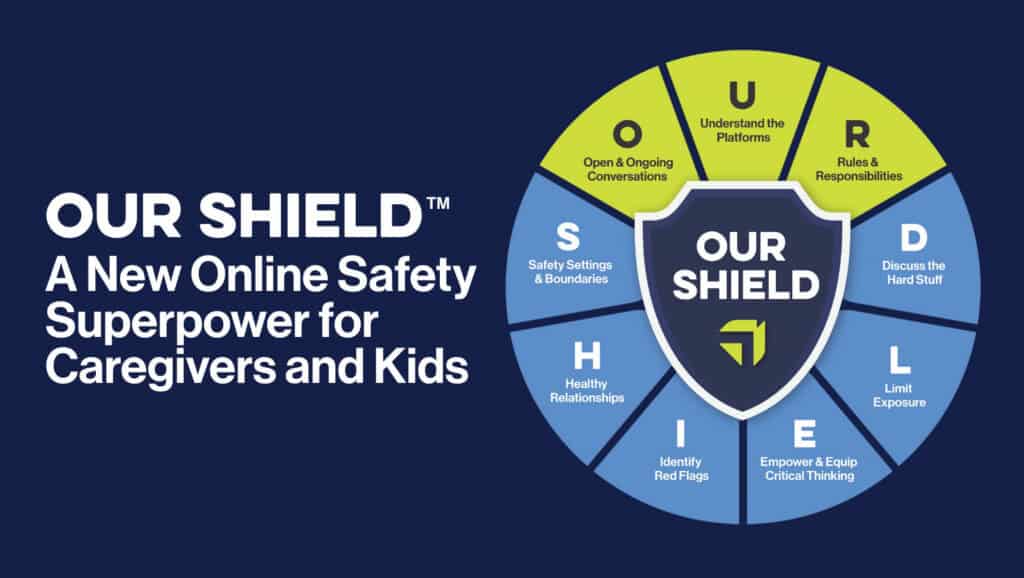
Tools like the Our Shield guide further support families and communities in setting shared boundaries and expectations.
What to Do If You Suspect Grooming is Happening to You or a Child
For parents and caretakers, if something feels concerning:
- Stay calm and supportive
- Avoid confronting the suspected person directly
- Seek to understand the situation before responding to the situation – listen without blame or judgment
- Remind children that they are loved, believed, and not in trouble
- Preserve relevant information, including screenshots of messages and conversations, when appropriate
- Seek professional guidance and report concerns
If grooming is or may be occurring:
Stop engaging and immediately seek help from a trusted adult or law enforcement.
Report the incident to:
- The platform (where it happened),
- Local police – 911,
- The National Center for Missing and Exploited Children (NCMEC) manages the “CyberTipline” to report child sexual exploitation, including child sexual abuse material. Submit a tip directly or by calling 1-800-THE-LOST (1-800-843-5678).
Consider. In the case of you or a loved one are affected by the sharing of non-consensual or exploitative images:
- Request removal directly from the platform(s), which they are legally required to do under the Take It Down Act
- Learn more about the Take It Down Act and how to work with the Federal Trade Commission if an app or platform does not remove
- Resources:
- Utilizing NCMEC’s free Take It Down resource (to help remove exploitative shared images of minors)
- Utilizing Stop Non-Consensual Intimate Image Abuses resource (to help remove non-censual images of adults)
Get Help and Support. It is okay. Tell a trusted person – a friend, family member, teacher, or counselor. Support, referrals, and additional resources are available here.
Save the Evidence and Keep a Record. Do not delete anything. Take screenshots and keep records of everything—the messages, the user profile, usernames, and any payment information. These details are crucial for law enforcement to apprehend criminals.
Block the Perpetrator. Use platform tools to block them on all accounts. Consider deactivating your account temporarily to prevent further harassment. (Do not delete or cancel it.)
Remember Prevention Is Protection
Grooming thrives where there is silence, uncertainty, and isolation. Prevention thrives where knowledge is shared, conversations are ongoing, and communities take responsibility together. When families, educators, and organizations invest in prevention, they help create environments where children are safer, supported, and empowered to seek help early. Learning the signs, staying engaged, and building shared understanding are not just protective steps—they are acts of care. Prevention is not only possible; it is essential to reduce harm and keep children safe.
Learn the signs. Start the conversation in your home and community. Stay engaged.