For someone experiencing homelessness, an emergency shelter can provide a safe place to sleep, a hot meal, and connections to resources that can start them in a new direction. It can also offer hope, care, stability, and a sense of connection – a place where one can seek refuge.
Shelters are often on the frontlines of Human Trafficking because people experiencing homelessness have a higher chance of being human trafficked. In a Polaris survivor survey, “64% of respondents reported being homeless or experiencing unstable housing when they were recruited into trafficking.”
Risk factors for human trafficking increase among youth. According to the National Network for Youth, one in five runaway and homeless youth are a victim of human trafficking – inclusive of sex and labor trafficking.
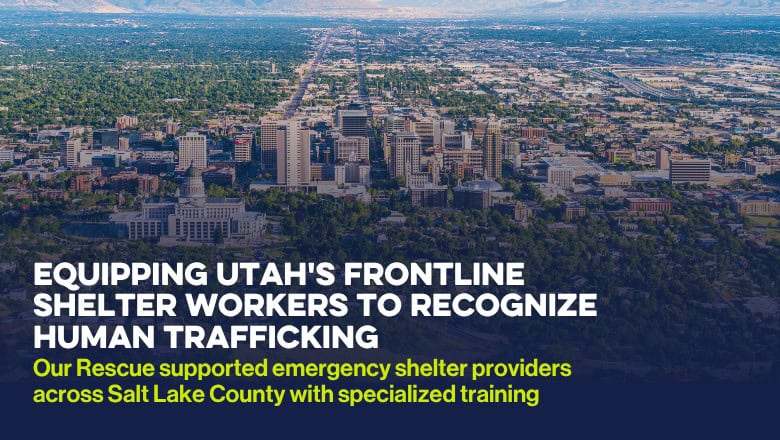
At Our Rescue, we believe in the power that knowledge and resources hold to disrupt the dynamics between traffickers and their victims. That’s why we recently supported emergency shelter providers across Salt Lake County with specialized training for those on the frontlines of the homelessness crisis.
While the State of Utah may be a geographical intersection, where the cardinal points converge, shelters are another kind of intersection between homelessness and human trafficking. The goal of this training was to help shelter employees learn to recognize and address this threat and give shelter staff tools to better support persons being harmed or exploited.
More than 80 direct-care staff, case managers, and clinicians gathered for Our Rescue’s training. In 90 minutes, they learned how to recognize the warning signs of trafficking and gained a better understanding of how traffickers target individuals experiencing homelessness. The training also discussed ways to respond to concerns with compassion and confidence.
These professionals are often among the first people individuals in crisis encounter. Emergency shelters operate around the clock and provide low-barrier access to essential services. They represent a lifeline for people with nowhere else to turn.
Training Sharpens the Frontline Defense
By equipping shelter staff with practical knowledge, Our Rescue helps strengthen a critical space for unhoused persons to receive services and help better protect them against exploitation.
Throughout the training, participants explored the complex relationship between homelessness and human trafficking, including the factors that increase vulnerability and the tactics traffickers commonly use to groom and exploit victims experiencing homelessness. They learned how to recognize human trafficking indicators, respond using trauma-informed practices, and connect victims and survivors with appropriate resources.

Discover the online trainings available on our Training & Prevention Page.
Rather than focusing solely on theory, the training emphasized practical application. Participants worked through case studies based on real-world scenarios, discussing how to respond when someone chooses to report to law enforcement, and how to support individuals when they don’t.
Just as importantly, the training acknowledged the critical work these professionals already do every day.
Shelter staff routinely build trust with people. That trust can become the first step toward safety for someone experiencing exploitation. By expanding and reinforcing their understanding of human trafficking dynamics, these frontline workers are even better equipped to identify concerns early and provide informed, compassionate support.
Building a Support Network for Shelters
The collaboration didn’t end when the training concluded.
The following week, Our Rescue met with four separate shelter teams for one-hour capacity-strengthening sessions tailored to the specific populations they serve. These smaller discussions created space for participants to ask questions, examine real-world situations they encounter in their daily work, and receive additional one-on-one guidance from Our Rescue’s subject matter experts.
Human trafficking is often hiding in plain sight, especially among populations already facing significant hardship.
Recognizing it requires more than awareness: it requires training, trusted collaboration, and professionals who know how to respond with compassion and confidence.
When frontline professionals and persons experiencing harm have the knowledge to recognize the signs and the confidence to act, vulnerable individuals have a greater chance of finding not only shelter, but also safety, support, and a path toward lasting hope.