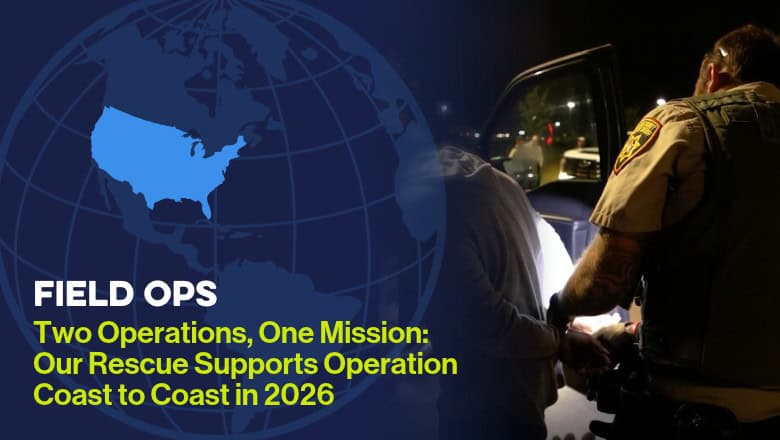
This year, Our Rescue supported two Operation Coast to Coast efforts to identify human trafficking victims and put their traffickers behind bars. These highly coordinated, multi-state operations were some of the largest in U.S. history bringing law enforcement, nonprofits, and private partners together to identify victims of human trafficking and hold traffickers accountable.
Operation Coast to Coast occurs every year and is organized and led by the Human Trafficking Training Center (HTTC). Our Rescue supports and strengthens this work by sponsoring dozens of HTTC trainings for hundreds of officers and helping fund operations so all participating agencies have the resources they need. In 2025, we sponsored more than 30 trainings and this year, we’ve sponsored about 20 with more to come.
Our Rescue made sure no agency sat on the sidelines for lack of funding
Dan Nash, Founder and CEO of HTTC
One of the Largest Anti-Trafficking Operations in U.S. History Helps Find Real Solutions
The fourth Operation Coast to Coast occurred in late April and was a vast collaboration involving more than 250 law enforcement agencies across 30 states, including the Missouri Attorney General’s Office and the Garvin County Sheriff’s Office about 60 miles south of Oklahoma City. The results speak for themselves: teams identified 129 victims, including 11 minors, and made 139 arrests, executed 108 search warrants, and seized over $500,000 in criminal assets.
Every participating agency was trained by HTTC with many of them supported by Our Rescue, a training that was designed to help law enforcement shift perspective toward a more victim-centered mentality.
“Several years ago, it was more focused on arresting [for] prostitution than seeing them as victims of human trafficking or sex trafficking,” said Sergeant Michelle Kieth with the Garvin County Sheriff’s Office. “This isn’t what people think it is…the problem isn’t the girls.”
In this Coast to Coast operation, authorities relied on their training, taking a trauma-informed approach and working with Safe House Project to connect survivors with vetted care partners. Our Rescue helped fund several police operations, while Marinus Analytics provided intelligence and trafficking leads, and Delta Airlines was standing by in case any survivors needed flights.
Seargent Keith and Forensic Interviewer Jordan Powers are featured in a short film about Coast to Coast and describe how the training has helped build greater understanding and empathy into the solution.
“We hear the term trauma-informed, but what does that really mean,” said Nate Davis, Vice President of North America Operations at Our Rescue. “For law enforcement, it means putting the victim and their needs first; before the ‘case’. This training helps police understand how trauma is at the root of trafficking and teaches a better way of understanding survivors that can help them get out of the cycle of human trafficking.”
Davis, a veteran police officer with over a decade of experience investigating human traffickers from Las Vegas to Africa and Asia, said, “Our hope is to help departments replace what may be an ‘arrest first’ mentality with a chance at actually getting these girls the help they need to break free from their traffickers, and to get off the street, to recover their freedom and live their lives.”
He recalls the surprise some women experienced when he didn’t arrest them. Instead, he offered to buy them a meal, or to get them medical attention. He didn’t treat them as criminals because he knew this lifestyle was influenced by their trauma and abuse.
“As police, we can’t expect these women to give us the name of their trafficker and the details of their trafficking on our first encounter. Their trauma triggers are going off. They are afraid of us, the police, going to jail, their trafficker, an aggressive sex buyer, their nightly quota, etc. They are going to lash out at us. The more vicious they are means the more help they need. Officers, don’t take it personal, look past that, treat them with kindness, with respect and compassion.” added Davis. “In my experience, they would sometimes return a few days later, willing to talk.
Once they realized I wasn’t going to arrest them, but truly wanted to help, they were able to trust me. Then they would be willing to come forward with information that was helpful in arresting their trafficker,
but that decision is always theirs, not ours. The survivor comes first, not our case. I promise if you do it this way, you will get more convictions and change more lives.”
“[You] can tell when somebody comes in that’s had the training versus people that haven’t,” said Forensic Investigator Jordan Powers. “I can really see a shift in their mindset of seeing her as a victim and not a bad kid.”
This is the kind of training that leads to meaningful, long-term change.
Encouraging Compassion and Understanding with a Trauma-Informed Approach
Our Rescue stands shoulder-to-shoulder with local law enforcement, before, during, and after field operations. In advance of operations, we provide training and digital forensics software, equipment and specialized resources like our Electronic Storage Detection K9s all of which are force magnifiers when it comes to investigating, arresting, and prosecuting human trafficking and child exploitation cases.
At every step in the field operations we support, Our Rescue’s survivor care teams are also frequently engaged, ensuring survivors have access to services and resources. We are also working alongside law enforcement to help build a trauma-informed mindset that shifts the relationship from “adversarial,” to one of understanding and compassion.
“We have found that victims respond well to law enforcement when they realize we’re not there to arrest,” said Davis. “Once they understand police are focused on their well-being, able to truly listen to their story, we’re there to help and that talking to us isn’t going to automatically land them in trouble…that’s when we have an opportunity to disrupt trafficking and exploitation. Because when you earn the trust and cooperation of a victim of trafficking, that person may share the information you need to put the trafficker away.”
This approach is more meaningful, and has lasting change for the victim – which in the end will make the community safer.
22 States, One Coordinated Response
On September 10, the New Jersey State Police Regional Operations Intelligence Center ran the next Operation Coast to Coast. Local, state, and federal agencies across 22 states provided services to 79 victims, including 5 juveniles, and made 125 arrests. The operation also recovered more than $1 million in currency and assets.
In the days that followed, partners connected survivors with food, lodging, medical care, counseling, and childcare. The same trauma-informed mindset helped officers give victims of human trafficking a chance to rebuild their lives, free from their captors.
“Lasting impact means giving officers the technology, training, and resources to sustain this work long-term, not just respond to a moment,” said Derek Benner, CEO of Our Rescue. “We’re trying to help law enforcement recognize when a commercial sex worker is a victim of human trafficking, and to make sure they’re equipped to respond appropriately – not with an arrest but with resources and trauma-informed support.”
Built to Last
Operations like Coast to Coast do not happen on accident. They take years of training, trusted partnerships, and resources that keep agencies ready and engaged long after a single day of action. Our Rescue is proud to stand alongside HTTC, Safe House Project, and the hundreds of agencies that carried out this work. We are also immensely grateful to the many generous donors who help Our Rescue stay in the fight to end human trafficking in communities across the U.S., Canada, and around the world. Your contribution directly empowers the fight.
Please Support the Frontlines. Donate and Join the Fight today.