A Minnesota case has recently alleged that an assistant county attorney built the corporate structures behind a five-year sex trafficking operation and that the same women who were sold for sex were later billed for as Medicaid clients. The professional standing was not incidental. It gave traffickers access.
By Amy Bruins, VP of Community Impact, and June Haskell, Director of Survivor Engagement
Amy Bruins is Vice President of Community Impact at Our Rescue and a licensed attorney with a JD and an MA in international human rights from the University of Denver. A native of Anoka County, Minnesota, she began this work at the University of Minnesota’s Aurora Center for Advocacy and Education and has since worked with survivors of trafficking and violence in the U.S. and internationally.
June Haskell is Director of Survivor Engagement at Our Rescue and a subject matter expert with lived experience of trafficking and interpersonal violence. For more than a decade she has trained law enforcement, prosecutors, government agencies, universities, Tribal Nations, and community organizations across the U.S. on trafficking, exploitation, trauma, and survivor-centered response.
Editor’s note: Every statement in this article describing conduct by named individuals reflects allegations contained in criminal complaints. No one described here has been convicted of any offense, and all defendants are presumed innocent. This case is actively unfolding; prosecutors have said additional charges are likely, and reported figures have varied between outlets as new filings emerge. We will update this piece as the case develops.
There is a version of this story that leads with the money — millions in false Medicaid claims, shell companies, an assistant county attorney who allegedly built the structures that hid the profits. It is the version most media outlets are telling, and it is not wrong. It is also a story that closes when the accounting is settled. If that is the case, it refuses to acknowledge the harm that was done to the victims. And by failing to address that harm, the story does nothing to disrupt the pattern of trafficking, especially when the case is so egregious and far from the norm.
Human trafficking only becomes preventable once someone describes it — particularly a pattern that does not look like what we have been taught to watch for.
Here is the version of this story that needs to be told.
The Charges at a Glance
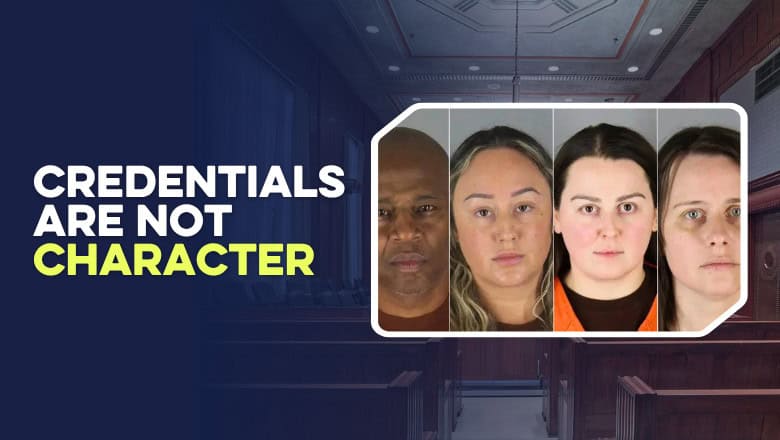
Hennepin County (filed August 2026). Frank Reeves, 57; Viktoriya Komonash, 30; Katherine Thomes, 36; and Andrea Sampson, 35, have each been charged with 26 felony counts: 13 of promoting the prostitution of an individual and 13 of receiving profits from prostitution. Bail was set at $1 million, or $300,000 with conditions, for Sampson and Komonash; and $1 million, or $500,000 with conditions, for Reeves. Sampson and Komonash have since posted bail and been released with conditions. Reeves and Thomes remain in custody.
Ramsey County (filed days later). Salman Ahmed Elmi, 30, was charged by the Attorney General’s Medicaid Fraud Control Unit with eight felony theft counts: three of aiding and abetting theft by swindle, five of aiding and abetting theft by false representation — tied to more than $1 million billed by Reva Health. He was held in lieu of $100,000 bail following a first appearance.
Both county attorneys have said the scope may expand.
Defendant Andrea Sampson worked for the Anoka County Attorney’s Office from 2017 until March 2026, assigned to Family Law and Civil Divisions. In February 2026, she was placed on leave when the office learned of the investigation and resigned in March. She was arrested on August 14, 2026. The Office has since begun reviewing her cases and referred her law license to the Office of Lawyers Professional Responsibility. State health regulators have acted, too: on August 21, 2026, the Minnesota Department of Health issued an immediate suspension and revoked the operating license of Homefelt Assisted Living, one of the properties prosecutors allege Sampson converted from a commercial sex house citing licensing violations that pose “an imminent risk of harm” to residents and barring Sampson from holding a service-provider license for at least five years.
What the Charges Describe
In August 2026, prosecutors in two Minnesota counties filed charges describing a single criminal enterprise with two revenue streams. The first case, in Hennepin County, describes a commercial sex operation. The second, brought by the Attorney General’s Medicaid Fraud Control Unit in Ramsey County, describes health care fraud. They share people, properties and — the complaints allege — victims.
The operation ran for at least five years across Minneapolis, Bloomington, Eden Prairie, St. Louis Park and nearby communities, and investigators began looking into it in 2021. Recruitment targeted young women who were unhoused, struggling with addiction, or under financial pressure. Apartments and houses were rented in their names using fabricated pay stubs. Victims described Frank Reeves, alleged to have been in charge of the operation, as a “pimp,” and Viktoriya Komonash as a “house mom.” Katherine Thomes allegedly owned the website where the women were advertised, Minnesota Erotica Personals, collecting fees for postings and for advertisement “bumps.” Andrea Sampson, who was an assistant Anoka County attorney at the time, allegedly secured properties where commercial sex took place and created LLCs that moved and concealed the money. This allegedly occurred between 2020 and 2026, including while Sampson was employed by the county. The complaints also describe Sampson’s own history inside the operation: investigators say she was first trafficked for sex within it, before her role shifted.
Thirteen women are named in the complaint. They told investigators they were required to pay for their own advertising and to leave at least $100 in envelopes at the houses for each sex act they were forced to perform. Prosecutors say Sampson owned the properties where these acts took place and where the women were also photographed for the advertisements. This means that women paid to be advertised, paid to be sold, and paid rent on the room they were sold in, all to the same people.
What the complaint describes goes well beyond a transaction. Multiple women said Reeves sexually assaulted them, and that others in the group witnessed the assaults or blocked the door. They reported being given alcohol and cocaine. Several said an armed man appeared when management was displeased. They described being watched constantly by people they called “management.” One began at 19 years old. One was 18.
What connects the two cases is the corporate structure. Charging documents allege that Reeves, Komonash, Sampson, and Elmi held ownership or management roles across four businesses registered with the Minnesota Department of Human Services: Reva Health, Reva Health Autism Center, Helpful Housing, and Homefelt Assisted Living. These businesses were enrolled to provide adult rehabilitative mental health services and early intensive developmental behavioral intervention for people with autism. Those businesses submitted roughly $4.65 million in Medicaid claims between May 2023 and February 2026.1
Prosecutors allege the co-conspirators recruited sex trafficking victims to serve as employees or clients of those providers, offering kickbacks to victims who collected personal information from Medicaid enrollees so that it could be used for billing. Sampson allegedly purchased two “commercial sex houses,” one of which was converted into an assisted living home. Investigators say two of Sampson’s three properties appear in the Medicaid billing and were also used to photograph victims for online sexual advertisements and to meet buyers.
That sequence is worth noting. A woman experiencing homelessness, addiction, or financial pressure is recognized as someone who can be exploited and is targeted. She is sold. Her name goes on a lease. Her name also goes on a claim form. When she says she wants out, she is instead offered a role inside the same network. Four revenue streams, one person, and at every step the paperwork looks more legitimate than it did before. The exploitation becomes harder to recognize while its outward appearance becomes more official.
JUNE HASKELL | SURVIVOR ENGAGEMENT LENS
This is where we have to be very careful with the word choice. From the outside, being offered a job inside the same network may look like an obvious continuation of exploitation. From the inside, the calculation can look completely different.
By that point, the person is not making a decision from a neutral starting place. The complaint describes women who said they had been sexually assaulted, watched, intimidated, given alcohol and cocaine, and exposed to an armed man when “management” was displeased. That history matters. You cannot evaluate a survivor’s later “yes” without understanding what she has learned can happen when she says “no.”
An offer of legitimate employment may therefore register as movement in the right direction: I don’t have to sell sex anymore. I can earn money another way. Maybe this is how I get out. The fact that we can see the larger structure from the outside does not mean the person inside it has the same information, alternatives, safety, or distance.
This is one of the places where people misunderstand survivor decision-making. We look at the choices we can see from the outside and ask, why would she choose that one? But the better question is often: what options did she believe were actually available to her, and what did she believe each one would cost?
Something can be exploitative and still feel safer than what came before it. Something can increase another person’s control while feeling like increased freedom to the person experiencing it. And a person can make the best decision available to them while still being inside circumstances someone else has deliberately constrained.
That is why “she agreed,” “she took the job,” or “she stayed” tells us very little by itself about whether the choice was meaningfully free.
When Exploitation Expands
What this case describes is human trafficking occurring across multiple forms: commercial sex, forced labor in the form of forced criminality, and benefits fraud.
In this case, the criminal scheme allegedly began by forcing women into commercial sex and later expanded to include Medicaid fraud. Medicaid fraud is a crime. What makes it forced criminality — a form of trafficking — is who was made to participate in it, and under what conditions.
Here, the complaints allege recruitment during homelessness, addiction, financial crisis, sexual assault, surveillance, supplied alcohol, an armed man at one of the houses, and cash the women were required to leave behind at the end of each shift. Those conditions did not end when the Medicaid work started. One woman told investigators that after she said she no longer wanted to work at the houses, the person who managed the operation’s bookings allegedly offered her a job at the autism center and set her hours there. These allegations are the difference between forced criminality and employment.
Why Disability Services Were the Vehicle
Disability service structures can be attractive fraud vehicles. The reason is structural and has nothing to do with the people these programs serve. Adult rehabilitative mental health services are billed in fifteen-minute units for work performed in someone’s home or community. These are services with no facility, no schedule overseen by a third party, and documentation that is produced entirely by the provider. Housing stabilization and autism services work similarly. Verification depends on paperwork the billing entity generates itself, and on a clinical supervisor whose signature is the only check. In this case, prosecutors allege there was effectively no qualified supervisor at all: the person who appeared on billing documents as a supervisor was never disclosed to the state for a required background study and was reportedly working more than full time elsewhere at the same time.2
People with disabilities face elevated human trafficking risk on every measure researchers have been able to construct. One analysis using nationally representative data found that adolescent girls with severe physical disabilities were 5.83 times as likely, and those with low cognitive ability 4.86 times as likely, to experience sex trafficking of a minor. A review of Florida case records found intellectual disability in 28 percent of child sex trafficking cases, against a national prevalence of roughly 1 to 3 percent. Traffickers may specifically seek out victims with disabilities in order to gain access to public benefits such as SSI or SSDI, and that dependence on a caregiver for basic needs can be exploited even when the caregiver is not the trafficker.
And the relationship runs both directions. The State Department has described the intersection as cyclical: people with disabilities are more likely to be targeted, and being trafficked can create or worsen disability through physical injury and psychological trauma, which in turn deepens vulnerability.
JUNE HASKELL | SURVIVOR ENGAGEMENT LENS
What strikes me is how many different parts of one person’s life can become something another person profits from. We tend to think about sexual exploitation primarily in terms of what is done to someone’s body, but exploitation can be connected to housing, labor, finances, credit, benefits, identity, and even a person’s name.
And those harms do not necessarily end when the trafficking ends. Someone may stop exploiting you long before you stop carrying the consequences of their exploitation. A survivor may physically leave and still carry debt, damaged credit, accounts or leases in their name, financial records they don’t understand, criminal exposure, or the enormous task of figuring out what was opened, signed, billed, borrowed, or otherwise done in their name.
That is one reason we must be careful about how we define “out.” No longer being sold does not necessarily mean someone has regained financial independence, control of their identity, or meaningful autonomy.
Sometimes the exploitation ends. Sometimes it changes shape. And sometimes what remains is the survivor trying to untangle the consequences that were created by the people who profited from them.
For me, financial empowerment in survivor care is therefore about much more than teaching budgeting or financial literacy. We also have to ask: What happened financially while this person was being exploited? What was opened, signed, borrowed, billed, or put in their name? Who controlled it? And what are they still carrying that was never truly theirs to begin with?
That same lens matters when we think about dependency and choice. One of the questions I would want a practitioner to ask is not simply, “Could this person say no?” but “What would saying no cost them?”
For a survivor with a disability, refusal may mean risking access to housing, transportation, personal care, medication, financial support, communication assistance, or other basic needs. A person can technically have the ability to say no while the consequences of saying no make that choice functionally unavailable or unsafe.
But I would not limit that question to disability. It is relevant across human trafficking situations. What does leaving or refusing cost this particular person? Housing? Income? Food? Transportation? Treatment? Childcare? Connection to family? Protection from withdrawal? Sometimes what looks from the outside like agreement, participation, or even a decision to stay makes much more sense once we understand what the person believes they will lose by saying no.
Support should increase a person’s options, not quietly make survival dependent on compliance.
Professional Skills, Public Trust
These are allegations. The case has not been tried, and Ms. Sampson is entitled to the presumption of innocence in full. The complaints also allege something that further complicates the situation.
Investigators say Sampson was first sold for sex within the same operation, before her position shifted and she became one of Reeves’s co-conspirators3. When that shift occurred — and whether it happened before or after she became an Anoka County attorney — is not established in the public record. Holding both of those facts does not cancel either one: her exploitation does not erase what prosecutors allege she did with her legal training, and what she is alleged to have done does not erase that she was, per the same complaints, once a victim of this same operation.
If allegations are proven, what is described is not simply alleged criminal conduct by someone who happened to be a lawyer. Prosecutors allege Sampson provided the locations and helped establish shell companies to conceal the profits — that is, her professional skill set was itself part of the alleged contribution. Entity formation, property acquisition, the architecture that makes money look clean. The Superintendent of the Bureau of Criminal Apprehension described a complicated scheme structured not only to exploit the victims but also to hide the proceeds of that exploitation through multiple individuals and shell companies.
Rachel Moran, a professor of law and director of clinical education at the University of St. Thomas School of Law, said anyone in a position of power involved in criminal activity should be held accountable whether or not the position itself was used, and that even if Sampson’s work was limited entirely to civil rather than criminal matters, a review should begin immediately when a government official in a position of authority is suspected of a serious crime committed while working for that office. That review is now underway: Anoka County Attorney Brad Johnson, noted that Sampson alleged conduct is “offensive to both the legal profession and the mission of [his] Office,” and Anoka County has referred the matter of her law license to the Minnesota Office of Lawyers Professional Responsibility.
There is another consequence of allegations like these that is harder to measure: what they do to the public’s trust in our government officials. A case like this can confirm exactly what an exploiter may already have been saying — that the people who claim to be there to help you are no different from anyone else.
That matters, because eventually we ask victims and survivors to trust an investigator, a prosecutor, an advocate, a clinician or a case manager enough to disclose what happened to her. We cannot demand that trust because we carry credentials. We have to behave in ways that earn it.
What to Look for
For at least five years these women moved through ordinary systems. They signed leases. They were enrolled as clients of licensed providers. Their names appeared on applications, claims, and bank records. Somewhere in that stretch a landlord, a clinician, a benefits worker, a bank teller, or a lawyer held pieces of relevant facts and evidence of this alleged scheme in their hands. We do not know what any individual professional may have noticed, questioned, or reported along the way. Someone may have sensed something was wrong but did not have the training to recognize it. What we do know is that nothing stopped this enterprise for five years, most likely because the arrangement kept producing the documents one would expect from a legitimate enterprise and because the people profiting were far from the kind of person one might suspect to be a trafficker.
What eventually led to this scheme’s discovery? Not a disclosure, not a tip, but rather a routine review by a health plan. This plan noticed that progress notes had been signed in batches, within the same minute or in rapid succession, and that a single clinical supervisor was reporting hours that could not be reconciled with full-time employment elsewhere. The plan referred the provider to the state’s Medicaid Fraud Control Unit, and when investigators there learned the owners were already the subject of a human trafficking investigation, the two cases became tied together. What caught this was a billing anomaly, not a person.4
Traditional screening can miss exploitation when the indicators are embedded in ordinary systems and legitimate-looking paperwork. That is a training problem before it is anything else. Traffickers do not fit one profile. What defines human trafficking is who and what the trafficker controls. Under Minnesota law, sex trafficking is recruiting, harboring, providing, or obtaining a person to aid in their prostitution or receiving profit or anything of value, knowing, or having reason to know it came from that illicit source.5
For providers and practitioners: Human trafficking for the purpose of benefits fraud is a form of labor trafficking and within labor trafficking, forced criminality.6
When benefits are in the picture, human trafficking indicators will likely look different than they would in other circumstances like commercial sex trafficking.
Watch out for the following indicators:
- A single person or entity appearing as landlord, employer, and service provider;
- Someone else receiving or directing the person’s benefits;
- A person being enrolled in services they cannot describe;
- A service plan, intake form, or claim signed by someone who does not know what it says; and
- A client who never seems to attend the appointments being billed.
Any one indicator may have an innocent explanation. When there are multiple indicators, that can describe a pattern in which someone else is monetizing this person’s identity.
For persons with disabilities, the indicators are similar but worth calling out. Traffickers may seek out victims with disabilities precisely because a benefits stream already exists in their name and because dependence on a caregiver makes refusal costly.
Watch out for:
- A representative payee, guardian or caregiver who is also the landlord, employer, or service provider;
- Enrollment in services arranged by someone who benefits financially from that enrollment;
- Forms, service plans, or claims signed by a guardian or caregiver without the person present;
- A person who is discouraged from meeting a provider alone, or whose appointments are always attended by the same third party; and
- Services billed that the person does not recognize, or support they need but never seem to receive.
There is a lesson here for every prevention curriculum we write, including our own. This case, if proven, describes an assistant county attorney, a licensed health care operator, an entrepreneur, and four businesses registered with the State of Minnesota — people holding professional licenses, advanced degrees, and public trust. Those accreditations were not incidental to the scheme. They were its infrastructure.
Legal expertise created the shell companies that moved the money. A health care license opened the Medicaid billing channel. State registration made four fraudulent operations look like four legitimate providers, and a property portfolio turned houses where women were sold into an assisted living company. Anyone can be a trafficker. Credentials are not character. In this case, they are access and sophistication.
What Has to Change and Where to Turn
JUNE HASKELL | SURVIVOR ENGAGEMENT LENS
This case is still in motion. Facts are still emerging, allegations have not been proven, and there is undoubtedly more that we will learn. But what has been alleged so far raises questions that are bigger than this case and worth asking now.
We spend a lot of time teaching people how to recognize human trafficking: know the warning signs, trust your instincts, ask for help, tell someone. All of that matters. But what we are learning from this case leads us to consider a harder question: How much responsibility are we placing on the person being exploited to successfully recognize and navigate exploitation?
We may be asking someone already living with fear, dependency, coercion, financial instability, or trauma to recognize that the job is not really an opportunity, the paperwork is not what it appears to be, the services being provided in their name may not actually be for their benefit, and the person carrying professional credentials may not be safe. Then we may ask them to determine who they can trust, disclose what happened, understand what may have been done in their name, recognize their own potential legal exposure, and find the right kind of help.
At some point, our systems have to become as sophisticated at recognizing exploitation as those who exploit others can be at disguising it.
That means we should absolutely continue teaching warning signs. But we also need systems that notice patterns, professionals who look beyond paperwork and titles, safeguards that do not depend on one trusted gatekeeper, and responses that recognize why someone may be afraid to disclose, leave, refuse, or cooperate.
And when someone does come forward, we should not begin by asking why they didn’t recognize what was happening sooner, why they stayed, why they signed, why they participated, or why they didn’t trust us.
We should be asking what made exploitation possible, what made leaving costly, what made help difficult to reach—and what we can change so the next person does not have to recognize and navigate all of it alone.
Minnesota Specific Resources
In Minnesota, several organizations may assist with finding an advocate or an attorney:
- Minnesota Bureau of Criminal Apprehension takes human trafficking tips independently, at 877-996-6222 or [email protected].
- Standpoint (1-800-313-2666) provides free legal advice and advocacy on human trafficking, sexual violence and domestic violence matters — no income requirement, no intake process, and you can share as little as you want.
- The Advocates for Human Rights (1-800-223-1368) provides free legal representation to human trafficking survivors whose household income is at or below 200 percent of the federal poverty guidelines.
- Day One (1-866-223-1111) can route you to a navigator or an advocate anywhere in Minnesota without having to file a police report.
- If you already have a conviction connected to your human trafficking, the Survivor Reentry Project connects survivors to pro bono attorneys for record relief.
Nationally: How to report human trafficking. The National Human Trafficking Hotline, 1-888-373-7888, is not law enforcement and will not report on your behalf without your consent.
This case leaves real questions unanswered, not just about what happened, but about what protection the law offers to victims and survivors in cases like these. We will publish a factual update on the case alongside a follow-up piece that looks at how to recognize exploitation from the inside, at a gap in Minnesota law that can leave some trafficking survivors without the protections they might expect, and at general information on finding legal counsel.
If you or someone you know is in immediate danger: Call 911
If you or someone you know is being trafficked:
- Minnesota: Contact the Minnesota Bureau of Criminal Apprehension at 877-996-6222 or [email protected], or the Day One Hotline at 866-223-1111.
- Nationally: The National Human Trafficking Hotline is available at 1-888-373-7888.
- Training and resources from Our Rescue: Our Rescue provides comprehensive anti-human trafficking training for professionals and communities, including sex trafficking, labor trafficking, and forced criminality — the form of exploitation described in this article, in which victims are coerced into committing offenses such as benefits fraud. We also offer resources tailored to providers who serve people with disabilities, covering identification, screening, and response in disability service settings. To request a training or connect with our Training and Prevention team, submit a request here.
- A note on the dollar figures: reporting has varied because outlets cite different measures drawn from separate complaints filed in different counties. KSTP reports approximately $4.65 million in total claims submitted between May 2023 and February 2026 — claims submitted, not the amount charged as fraudulent. CBS Minnesota reports more than $4.5 million billed since 2023. FOX 9 reports the Attorney General’s Office placing total billing across the businesses at roughly $2.5 million, with about $1.2 million tied to the assisted living homes. The Star Tribune reports that one converted property billed Medicaid for more than $500,000, while the Washington Examiner attributes that same figure to Homefelt Assisted Living as an entity with three associated addresses. The Attorney General’s charged figure against Salman Ahmed Elmi is over $1,000,000. Separately, the Attorney General’s August 17, 2026 announcement referenced approximately $1.5 million in total Medicaid fraud; that figure combines this case with an unrelated case against Mohamed Haji Rashid and Liberty Home Health Care, and should not be applied here. This article uses the total-claims figure and the charged figure, and does not attribute a dollar amount to any single property. Figures may be revised as additional charges are filed. ↩︎
- Ramsey County criminal complaint, State v. Elmi, No. 62-CR-26-5749, statement of probable cause, filed August 13, 2026, describing billing requirements for Adult Rehabilitation Mental Health Services under Minn. Stat. § 256B.0623, Early Intensive Developmental and Behavioral Intervention, and Housing Stabilization Services, and alleging that no licensed professional qualified to supervise ARMHS was ever affiliated with the provider. ↩︎
- Ramsey County criminal complaint, State v. Elmi, No. 62-CR-26-5749, statement of probable cause, filed August 13, 2026; see also Minnesota Star Tribune, August 2026, and FOX 9 Minneapolis-St. Paul, August 2026, reporting that investigators believe Sampson was first sold for sex within the operation before becoming a co-conspirator, and that the timing relative to her employment with Anoka County is unclear. ↩︎
- Ramsey County criminal complaint, State v. Elmi, No. 62-CR-26-5749, statement of probable cause, filed August 13, 2026, describing the health plan’s document review, the referral to the Minnesota Medicaid Fraud Control Unit, and the subsequent joint investigation with the Bureau of Criminal Apprehension. ↩︎
- Minn. Stat. § 609.321, subd. 7a. Related offenses appear at § 609.322. Minnesota’s definition is broader than the federal Trafficking Victims Protection Act, 22 U.S.C. § 7102, which for adult victims requires that the commercial sex act be induced by force, fraud, or coercion. ↩︎
- On forced criminality as a recognized form of trafficking, see U.S. Department of State, Trafficking in Persons Report, 2014, and Walts et al., 2023, identifying benefit fraud among its manifestations. Federal labor trafficking is defined at 22 U.S.C. § 7102 and Minnesota’s at Minn. Stat. § 609.281. No forced labor or forced criminality count has been charged in this case; the Hennepin charges are brought under Minn. Stat. § 609.322. The characterization here applies those definitions to the conduct the complaints describe. ↩︎