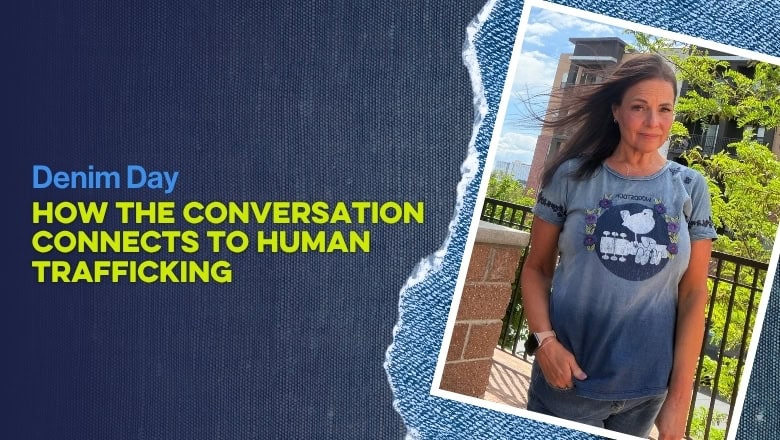
June Haskell brings over ten years of experience speaking as a survivor of sex trafficking, domestic violence, childhood trauma and drug endangerment. From policies and programs to events and media, June works as Director of Survivor Engagement at Our Rescue and is a valued and respected resource.
April is Sexual Assault Awareness Month, and that usually means we’ll see articles, social media posts, statistics and maybe even a colorful ribbon across a profile picture.
For a lot of people, it still feels like something you hear about every now and then. Maybe on the news. Maybe something you heard is happening to someone else.
Sexual assault can feel deceptively distant and often misunderstood.
But it becomes a lot less distant when we actually talk about it. So, let’s have a real conversation.
First, the reality is that sexual abuse is far more common and more complex than most people realize. It’s something that doesn’t simply fade with time.
“That was a long time ago, you should have moved on by now.” I’ve heard these words more times than I can count, or at least some version of them.
Move on. Put it behind you. It’s not that simple.
I have a friend who still talks about the time a restaurant got her order wrong, and it’s been many years since the “incident.” They gave her fish instead of chicken, and it still comes up anytime we talk about where to eat. My friend was given something she didn’t like, but she was able to send it back, make it right, and left with a full belly. Her tale of injustice is often met with a sigh, sometimes a laugh, requesting she move on and let it go. But we’re not talking about getting the wrong dinner plate.
For those of us who have experienced sexual assault, it shapes how we see the world and everyone in it. It doesn’t just stay in the past, and you can’t simply “move on.” We carry it forward with us. It affects how we move through every situation. The word “safe” now has a new meaning and now our response to all of life’s challenges, big or small – they are all different than before. Learning how to exist in a version of the world that feels fundamentally different than it did before – this is the new normal.
This matters because these traumatic experiences can shape vulnerability, relationships, and all sorts of situations we end up navigating later on.
So, what does this have to do with trafficking? Glad you asked.
When people hear “sexual assault” or “exploitation,” they tend to think of something separate from trafficking. Trafficking is viewed as something more extreme, more obvious, and easier to define.
But in reality, there’s often overlap. It’s important to know that: not every survivor of sexual assault will experience trafficking, but many who are trafficked have histories of sexual abuse. Research underscores this connection, with some studies finding rates of childhood sexual abuse among trafficking survivors as high as 88%, though estimates vary across populations.
And that was something I didn’t fully understand at first.
When I first started learning about human trafficking, I had a lot of questions.
One thing that stood out to me early on was learning that prior sexual abuse is identified as a vulnerability to exploitation. In my mind, those experiences had made me more aware and on guard. So how did that make me vulnerable? I remember not understanding at all.
So I dug in.
I read, listened, and talked with people who specialize in trauma, sexual assault, especially childhood trauma and sexual abuse. It wasn’t long before I started to learn more and found myself hearing a language that put words to what I had been feeling for years.
That’s when it began to make sense.
Experiencing sexual abuse, especially as a child, can shape how you see yourself in ways you don’t always realize at the time.
Without even realizing it, I had internalized beliefs and had been labeling myself for years:
weak
damaged
broken
ashamed
unworthy
different
disposable
less than
helpless
Sound familiar? That’s because we all have moments where we feel similar emotions. It can also blur your understanding of boundaries. When those boundaries are violated early on, it becomes harder to recognize when they’re being crossed later. Or if they even mattered in the first place.
When the person who was supposed to protect you, love you, care most about you, when they are the one causing harm, it changes how you understand trust and even what “love” looks like.
This is where vulnerability comes in.
Imagine a young girl just like me, carrying those same beliefs about herself. Now picture that someone comes along; someone who knows exactly how to present themselves as the opposite of all of that. Someone who knows exactly what they are doing. He offers attention, validation, or a sense of worth. It’s scary to look back now and realize how vulnerability from traumatic experiences had changed my perspective. It had indeed made me vulnerable.
Vulnerability means when the wrong “someone,” a wolf in sheep’s clothing, shows up, it doesn’t always look like a warning. Sometimes it looks like relief.
However, when you have experienced trauma like sexual assault, abuse and trafficking, those beliefs don’t just stay in your head. They shape what feels normal, what feels possible, and what you believe you deserve.
That distortion doesn’t just affect how you feel, it affects what starts to feel normal.
When sexual abuse happens during the time you’re developing your sense of self, it can send a very specific message: that your value is tied to your body, to sex, or to what you’re willing to give to someone else.
Understanding this doesn’t excuse exploitation, but it does give us insight into how it happens. And more importantly, it shows us where real power is. It is in all of us.
It is in recognizing vulnerability early, in meeting needs before someone else exploits them, and in making sure the right people show up first.
When we understand how vulnerability is created, we also understand how to reduce it. Through trauma-informed support, stability, and helping people rebuild a sense of worth that isn’t dependent on someone else. We can take those vulnerabilities and strengthen them. We can do this as individuals, parents, friends, neighbors, and even communities.
This is so important because those beliefs don’t just affect how you see yourself; they shape how you experience everything that comes after.
Like trafficking, sexual assault doesn’t just affect a moment in time, it affects how someone experiences the world moving forward.
How we feel in our own body and how we see ourselves is drastically different. The shift in perspective changes everything. How they trust, make decisions, respond to stress, and even how they’re perceived by systems that are supposed to help them. It can feel like being dropped into a completely different world and still be expected to function like nothing has changed.
But everything has changed.
Many survivors of sexual assault aren’t just navigating what happened to them; they’re navigating everything that comes after.
Housing.
Stability.
Relationships.
Access to care and resources.
They’re trying to find their footing in a reality that no longer feels safe or predictable. And when that sense of safety is gone, their brain adapts by going into pure protection mode, and they become more guarded, more alert. Their reality has shifted into constant survival mode. It’s the new normal.
This is also where some of the biggest gaps show up because support isn’t always designed for that reality.
Here is where the connection to trafficking becomes really important.
Exploitation happens where there’s vulnerability. When needs aren’t met, there is vulnerability. When there’s instability, isolation, or a lack of support – who shows up in those moments that can make all the difference.
When we start to understand all of this, the impact, the vulnerability, and the gaps, the next question becomes:
What can we do? This is the question that matters most.
Once we understand the impact of sexual assault, vulnerability, and trafficking, what can we do to actually make a difference?
Truthfully, what helps isn’t that complicated, but it does require intention.
1. Safety. Real, consistent safety. Not just physical, but emotional. A space where you’re not constantly on guard, waiting for the next thing to go wrong. A place where you can express your thoughts, feelings, hopes, and fears without that sense of risk.
2. Stability. Housing. Access to care. Knowing what resources are available and how to access them. Basic needs being met. Bottom line: It’s hard to focus on healing when you’re just trying to survive the day.
3. People Showing Up the Right Way. Not to try and fix us. Not to push. Not to ask for more than someone is ready to give. But to listen. To be patient with us. To be consistent and respect boundaries even when it’s hard. And it will be hard. Because at first, fear often comes across as anger.
Like many survivors, I protected myself by automatically assuming people would let me down. It’s safer to assume the worst and not count on anyone to genuinely care. So, even when it is hard, when someone shows up differently – genuinely, consistently and safely – it matters more than most people realize.
It’s often in those small, unexpected moments of genuine support that something begins to shift for survivors.
I remember that shift very well. For me, it was a moment when “impossible” was replaced with “maybe” and soon a little trust was given. A small sense of safety. The slightest glimmer of hope.
And sometimes, that’s enough to step out of survival mode, even briefly, and begin to believe something different is possible. That’s where healing started for me – years ago when someone said I deserved better, and for the first time, I believed them. Little by little as resources and support came wrapped in authentic genuine care for me as a person, trust was built, and I began to see and believe in what was possible instead of what had been.
This is why I’m grateful to be part of an organization working to strengthen that kind of support every day through partnerships, programs, and people who understand what it really means to show up.
I know first-hand how joining forces in big or small ways can have a huge impact. And now you know too. Whether it’s choosing to learn more, to pay attention, to support survivor-centered work, or simply to show up differently in your own circles, those actions –our actions– make a difference.
April is Sexual Assault Awareness Month. Because awareness matters. But what we do with that awareness matters even more.
– June Haskell, Director of Survivor Engagement, Our Rescue