
Artificial intelligence (AI) is no longer a distant concept or a futuristic tool reserved for tech labs and movies. It’s here, embedded in everyday life, accelerating innovation across industries, and reshaping how people learn, work, and connect. And, like many transformative technologies before it, AI is neither inherently good nor evil. It is a tool, one shaped by the intent of those who wield it.
In the fight against child exploitation, this duality is impossible to ignore. AI has the power to accelerate detection, support investigations, and help protect vulnerable children at an unprecedented scale. Yet that same technology is a serious threat. Often enabling new forms of harm that moves faster and spreads farther than ever before.
At Our Rescue, we work alongside law enforcement, investigators, and prevention experts who see both sides of this reality every day.
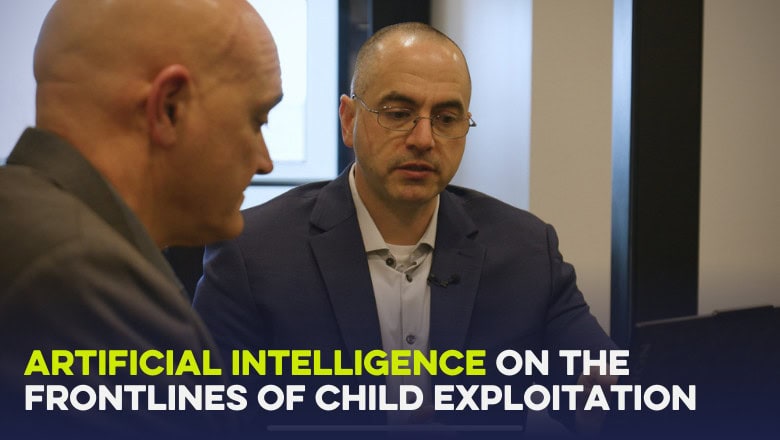
Recently, we sat down with Eric Jollymore, who is the Assistant Director of Digital Forensics at SEARCH, the National Consortium for Justice Information and Statistics, with more than a decade of experience in law enforcement and digital forensics.
Jollymore explained how AI can help identify survivors faster, process overwhelming volumes of digital evidence, and support investigations that once took years. At the same time, the same technology is being weaponized to exploit, manipulate, and harm children in ways that are difficult to detect and even harder to undo.
Understanding that tension matters. Because how we respond now will shape what the internet becomes for the next generation.
The Mass Production of AI Exploitive Images
Last year alone, more than 36 million reports of child sexual abuse material (CSAM), otherwise known as child pornography, were made to the National Center for Missing & Exploited Children—a number that continues to climb each year.
Predators used to need access to real children to create CSAM. But with emerging AI technologies, that is no longer the case. In 2024, reports to NCMEC’s CyberTipline involving generative AI surged by 1,325%, rising from roughly 4,700 the previous year to about 67,000.
“I remember getting one of my first cases with a million media files and thinking, ‘Thank goodness this is rare,’” Jollymore recalls. “Now, I can generate a single image in 20 seconds, put it on a loop, go to bed, and wake up to thousands of images.”
“It’s Not Real, So Why Does It Matter?”
One of the most common misconceptions surrounding AI-generated child sexual abuse material (CSAM), often known as child pornography, is the idea that it isn’t “real.”
If an image is synthetic, some argue, no one was harmed.
Investigators see it differently.
“AI-generated child sexual abuse material may not depict a living child,” says Jollymore, “but it does start the process of normalizing abhorrent behavior.”
Today, widely available tools, many of which are free, can generate highly realistic images using just a handful of reference photos. In some cases, a single image pulled from a public social media account, a school website, or even a photo taken in a public place can be enough to create a convincing likeness of a real child.
When those images are created, used, or distributed, the child is still being victimized.
The harm doesn’t end with creation. Once material enters online spaces, it is extraordinarily difficult, often impossible, to remove completely. Investigators regularly encounter the same images resurfacing years later across multiple cases. What begins as a single image can follow a child into adulthood, resurfacing again and again without their consent or control.
Even when an image is fully synthetic and does not depict a specific child, it still plays a dangerous role.
“If we accept AI-generated child sexual abuse material as no big deal,” Jollymore warns, “predators get that much closer to hands-on abuse.”
The creation and consumption of AI-generated CSAM contributes to the normalization of abusive behavior. Over time, that normalization lowers barriers and increases the risk of hands-on sexual abuse.
“When individuals are using this type of material for their own personal desires, it works to normalize that behavior,” Jollymore explains. “It reduces the barrier for them to make an actual contact offense with a real, authentic human being.”
It becomes a gateway that pulls individuals closer to real-world harm.
The Hidden Cost: Investigator Trauma
Behind every digital investigation are real people tasked with sorting through overwhelming volumes of disturbing material.
AI has dramatically increased that volume.
What once might have been thousands of files can now be hundreds of thousands—or millions—generated automatically and continuously.
“There might be 100,000 images on one phone,” he says. “And we seized 15 phones. One of them might be real. It’s your job to find that.”
Investigators must still examine that material carefully. Somewhere in the noise may be the one real image that identifies a child who needs help.
A Power for Good
That work takes a toll.
“We’re asking investigators who are already overwhelmed to dig harder, dig deeper, and with more attention to detail than ever before,” Jollymore says. “It’s consistently upsetting, and it’s an untold amount of stress.”
Exposure to repeated trauma, coupled with mounting backlogs and limited resources, increases the risk of burnout among the very professionals communities depend on to protect children.
Yet, ironically, AI is also part of the solution. Emerging tools are also helping investigators triage material more efficiently and identify patterns faster. Used responsibly, AI can reduce workload, speed investigations, and lessen the emotional burden on those doing this work.
“There are some really great tools that are evolving out there to be able to help investigators get through some of that material. And some of those tools are actually AI. We’re using AI-related tools to look for AI-related material,” explains Jollymore.
A Tool, Not a Verdict
AI is neither inherently good nor inherently harmful. It reflects the intent of those who use it.
The same technology that enables exploitation can also help prevent it by supporting investigations, training professionals, educating families, and strengthening safeguards online.
At Our Rescue, we focus on equipping communities with knowledge, supporting law enforcement with training and resources, and advancing prevention efforts that keep children safer in an evolving digital landscape.
This moment calls for clarity, collaboration, and vigilance, not panic.
So, what can individuals and families do when faced with AI and child exploitation?
The Internet Has Changed and Parenting Must Change with It
For parents and caregivers, the goal is not fear, it’s awareness.
The internet today is fundamentally different from the one many adults grew up with. Screens are woven into classrooms, social lives, and daily routines. Online interactions no longer stop when a child gets home from school. Connectivity is constant.
“The internet you grew up with is not the same internet your child is growing up with,” Jollymore says. “This is a 24-hour cycle now. Once you got off the bus, school stayed at school. That’s no longer the case.”
That reality requires new conversations and new habits.
Open communication is one of the strongest protective factors. Children need to know they can come forward to safe adults without fear of punishment or shame if something feels wrong. Trust, built early and reinforced often, matters more than any single setting or app.
Parental awareness also extends to what information is being shared publicly about their child. Small details can add up: visible house numbers, school logos on clothing, last names on jerseys, location tags in photos.
“Is your house number visible in that photo? Is the license plate visible? Does the jersey show their name or town?” Jollymore asks. “People can extract those details and connect the dots.”
It’s important that parents are sharing their lives online thoughtfully, understanding that images and information can be reused in ways that were never intended for.
When a Child Is Targeted, They Are Not to Blame
When AI is used to extort, manipulate, or threaten a child, the response matters.
Children in these situations are victims—full stop.
“The child is the victim,” Jollymore says. “This is not the time to place blame. You need to walk alongside them and support them.”
Whether an image is synthetic, manipulated, or shared under coercion, blame has no place in the conversation. What children need most is support, reassurance, and adults who will walk alongside them through what comes next.
From an investigative perspective, there are also critical first steps. Devices involved should be treated as crime scenes.
“Put the device in airplane mode. Don’t clean it. Don’t purge it,” Jollymore advises. “As hard as it is, preserving that information can help stop someone from harming another child.”
Our Rescue works to ensure families, communities, and frontline responders have access to clear guidance and support when these moments arise, because no family should have to navigate this alone.
The question isn’t whether AI will shape the future. It’s whether we are willing to shape it responsibly, with children’s safety at the center of every decision.
Learn what steps you can take today to protect your child today by visiting Our SHIELD.